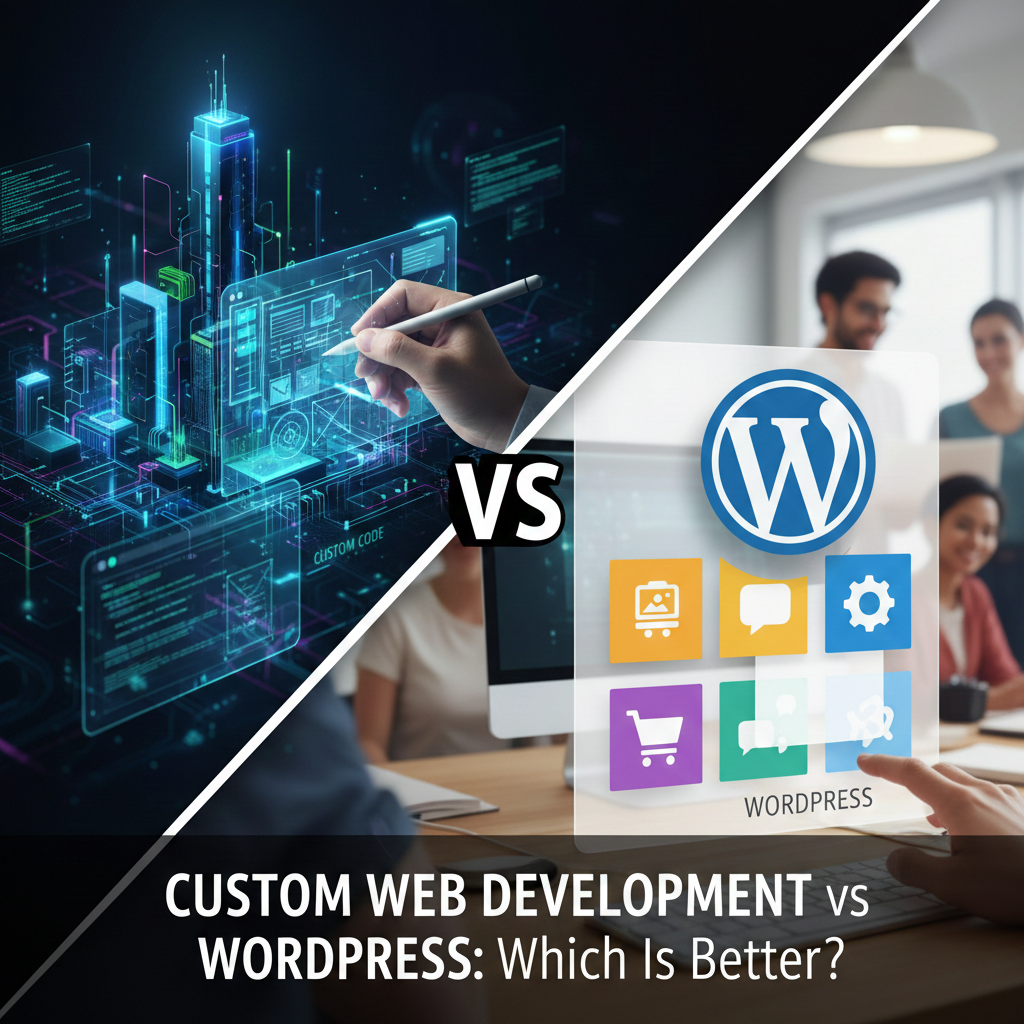
In 2026, your website is no longer just a digital business card; it is a high-performance engine that drives revenue, brand authority, and customer engagement. As search engines evolve into “Answer Engines,” the debate between custom web development vs WordPress has taken on a new dimension.
Businesses today face a critical choice: Should you build a bespoke platform from the ground up or leverage the world’s most popular Content Management System (CMS)? While WordPress powers nearly 44% of the web, custom-built solutions are gaining ground for enterprises that prioritize speed, security, and unique AI integrations.
In this comprehensive guide, we will break down the differences to help you decide which path aligns with your commercial goals.
1. Understanding the Core: Custom Web Development vs WordPress
To make an informed decision, we must first define the two contenders.
WordPress is an open-source CMS that allows users to build websites using a pre-existing framework, themes, and plugins. It is highly accessible and offers a modular approach to web design. On the other hand, custom web development involves writing unique code (often using frameworks like React, Next.js, or Vue.js) to create a site tailored specifically to a brand’s requirements.
When comparing custom web development vs WordPress, the primary difference lies in the “foundational DNA” of the site. WordPress is like a pre-built house that you can renovate; custom development is like hiring an architect to design a mansion from scratch.
Key Takeaway: Choose WordPress for speed and familiarity; choose custom development for total control and high-performance scalability.
2. The Business Pros and Cons of WordPress
If you are looking for a cost-effective and rapid entry into the market, looking into WordPress website pros and cons is the best place to start.
The Pros
- Speed to Market: You can launch a functional WordPress site in days or weeks using professional themes.
- User-Friendly Interface: Your marketing team can update content, post blogs, and change images without knowing a single line of code.
- Huge Ecosystem: With over 60,000 plugins, you can add features like e-commerce (WooCommerce), SEO tools (Yoast), and contact forms instantly.
The Cons
- Plugin Bloat: Over-reliance on plugins can slow down your site, negatively impacting your Google Core Web Vitals.
- Security Risks: Because it is the most popular platform, it is a frequent target for hackers. 96% of vulnerabilities in WordPress sites come from outdated plugins or themes.
- Maintenance Burden: You must constantly update the core software, themes, and plugins to prevent site breakage.
In the context of custom web development vs WordPress, these pros and cons highlight why WordPress remains a favorite for SMEs but often falls short for complex enterprise needs.
3. The Power of Custom Web Development for Growth
For businesses with specific workflows, high security requirements, or the need for unique user experiences, a custom CMS or bespoke build is often the superior choice.
When you opt for custom web development vs WordPress, you eliminate the “bloat” of unnecessary code. This leads to:
- Lightning-Fast Load Times: Custom sites only load what is necessary, which is crucial for ranking in 2026’s performance-heavy search landscape.
- Scalability: As your business grows from 1,000 to 1,000,000 users, a custom infrastructure can be scaled horizontally and vertically without the limitations of a template.
- Enhanced Security: Since the codebase is unique, it doesn’t suffer from the “mass exploits” that target popular CMS platforms.
While the initial investment in custom web development vs WordPress is higher for custom work, the long-term ROI is often better for high-traffic businesses due to lower maintenance and higher conversion rates.
4. Cost Comparison: Initial Investment vs. Long-Term ROI
Budget is often the deciding factor. Let’s look at the financial reality of custom web development vs WordPress in 2026.
| Feature | WordPress Website | Custom Web Development |
| Initial Cost | $500 – $5,000 | $15,000 – $100,000+ |
| Development Time | 2 – 4 Weeks | 3 – 6 Months |
| Monthly Maintenance | $50 – $200 (Hosting + Updates) | $200 – $1,000 (Developer Retainer) |
| Scalability | Moderate (Plugin dependent) | High (Bespoke Architecture) |
While WordPress is cheaper upfront, a custom CMS can save money over time by eliminating expensive premium plugin subscriptions and the need for frequent redesigns when your business outgrows a template. In the battle of custom web development vs WordPress, the winner depends on whether you are optimizing for today’s budget or tomorrow’s expansion.
5. SEO and AEO: Which Platform Ranks Better in 2026?
Search Engine Optimization (SEO) has evolved into Answer Engine Optimization (AEO) and Generative Engine Optimization (GEO). Your site must now be readable by both humans and AI models like Gemini and ChatGPT.
- WordPress for SEO: With plugins like RankMath, WordPress makes it easy to handle meta tags and sitemaps. However, excessive code bloat can hurt your “PageSpeed Insights” score.
- Custom Development for AEO: A custom site allows for precise Schema Markup and clean semantic HTML. This makes it easier for AI “Answer Engines” to extract direct snippets from your content.
When evaluating custom web development vs WordPress, remember that Google’s 2026 algorithms prioritize “User Experience” (SXO). A custom-built site often provides a smoother, faster experience that search engines reward with higher rankings.
6. Scalability and Future-Proofing Your Business
Can your website handle a viral marketing campaign?
In a custom web development vs WordPress comparison, scalability is where custom builds shine. A custom site can be integrated with advanced AI agents, IoT devices, or complex ERP systems that a standard WordPress setup might struggle to support.
However, if your business model is straightforward—such as a consulting firm or a local service provider—a custom CMS might be overkill. WordPress is more than capable of handling moderate growth, provided you invest in high-quality managed hosting and professional optimization.
7. Security and Data Privacy Standards
With the rise of global data privacy regulations in 2026, security is a non-negotiable commercial requirement.
In the custom web development vs WordPress debate:
- WordPress requires constant vigilance. You must implement firewalls, 2FA, and regular backups.
- Custom Development allows you to build security into the “application layer.” Since the code isn’t public, hackers can’t find common vulnerabilities as easily.
For industries like FinTech, Healthcare, or Legal, the security benefits of a custom CMS usually outweigh the convenience of WordPress.
8. Final Verdict: Which One Should You Choose?
The choice between custom web development vs WordPress boils down to your specific business stage and goals.
Choose WordPress if:
- You are a startup or small business with a limited budget.
- You need to launch your website as quickly as possible.
- You want your internal team to manage all content without technical help.
- You are comfortable with the trade-offs in WordPress website pros and cons.
Choose Custom Web Development if:
- You are an established brand looking for a unique digital identity.
- You require complex functionality or deep integrations with other software.
- High-speed performance and AEO/GEO optimization are your top priorities.
- You want a custom CMS that grows exactly as your business does.
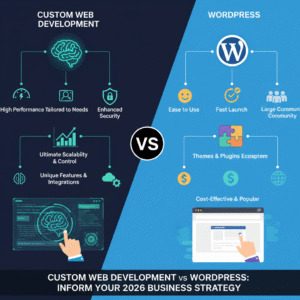
Frequently Asked Questions (FAQs)
- Is custom web development vs WordPress better for SEO?
Both can rank highly on Google, but they offer different advantages. WordPress is excellent for beginners because of plugins like Yoast SEO that automate technical tasks. However, custom web development allows for “cleaner” code and faster load speeds, which are critical for Core Web Vitals and AEO (Answer Engine Optimization). In a highly competitive niche, the performance edge of a custom site often results in better rankings.
- What are the biggest WordPress website pros and cons for a growing business?
The biggest pro is the ability to scale content and add features quickly via plugins. The biggest con is “technical debt”—as you add more plugins, your site becomes slower and more prone to security vulnerabilities. For a business scaling past a certain point, the maintenance of a heavily modified WordPress site can actually become more expensive than a custom CMS.
- How much more does custom web development cost compared to WordPress?
Generally, a professional WordPress site ranges from $2,000 to $10,000. Custom web development typically starts at $15,000 and can exceed $100,000 depending on complexity. While the upfront cost is higher, custom builds often have a higher ROI for enterprises because they are built to convert specific user personas without the limitations of a pre-made template.
- Can I migrate from WordPress to a custom CMS later?
Yes, you can migrate, but it is a complex process. You will need to export your database and map your content to the new architecture. If you anticipate needing complex, bespoke features within the next 18–24 months, it is often more cost-effective to invest in custom web development vs WordPress from the start to avoid the “re-platforming” headache later.
- Which option is more secure for handling customer data?
Because WordPress is open-source and powers millions of sites, it is a frequent target for automated bot attacks. A custom CMS provides “security by obscurity”—your code is unique, making it much harder for hackers to find universal backdoors. For businesses handling sensitive data (PII), custom development is the gold standard.
- Do I need a developer for a custom web development project?
Absolutely. Unlike WordPress, where a marketing manager can make many changes independently, custom web development vs WordPress requires a dedicated developer or agency to handle updates and feature additions. However, many custom builds include a simplified “admin panel” tailored to your specific needs, making daily content updates just as easy as WordPress.
Conclusion: Making the Strategic Move
Both paths offer a route to digital success, but the “better” option is the one that supports your long-term vision. Whether you choose the flexibility of custom web development vs WordPress or the streamlined efficiency of a template, your focus should always be on the user experience.
In 2026, the brands that win are those that provide fast, secure, and authoritative answers to their customers’ questions.
Read our other articles:
The Critical Importance of Brand Identity for Modern Business
Top 10 Effective Branding Strategies For Startups in 2026
Top 7 Web Development Trends 2026 You Must-Know
Custom Website vs Template? The Ultimate 2026 Guide
SEO for Small Businesses: The Ultimate 2026 Growth Guide
10 Best Social Media Marketing Tips for Small Businesses
10 Critical Digital Transformation Benefits for Growth
Scaling Businesses with Tech: The Ultimate 2026 Guide
10 Pro Tips to Choose the Best Web Development Company
Website Redesign Checklist: The Ultimate 2026 Guide