A logo is often the first point of contact between a business and its audience. It functions as the visual “handshake” of your brand.
However, even seasoned entrepreneurs frequently fall into traps that result in amateurish or confusing visuals. Understanding common logo design mistakes is the first step toward creating a brand identity that resonates and endures.
In this guide, we will explore the pitfalls that lead to branding errors and how opting for professional logo design can save your business time, money, and reputation.
Let’s get started.
1. Relying on Trendy Design Elements
One of the most frequent logo design mistakes is chasing fleeting design fads. While it is tempting to use the “gradient of the year” or a specific “minimalist line art” style that is currently viral, trends age rapidly.
A logo should be timeless.
If your visual identity is built on a trend, it will look dated within twenty-four months, leading to costly branding errors. To achieve a professional logo design, focus on classic principles like balance, proportion, and hierarchy rather than what is currently trending on social media.
2. Using Low-Resolution Raster Images
Technical errors are just as damaging as aesthetic ones.
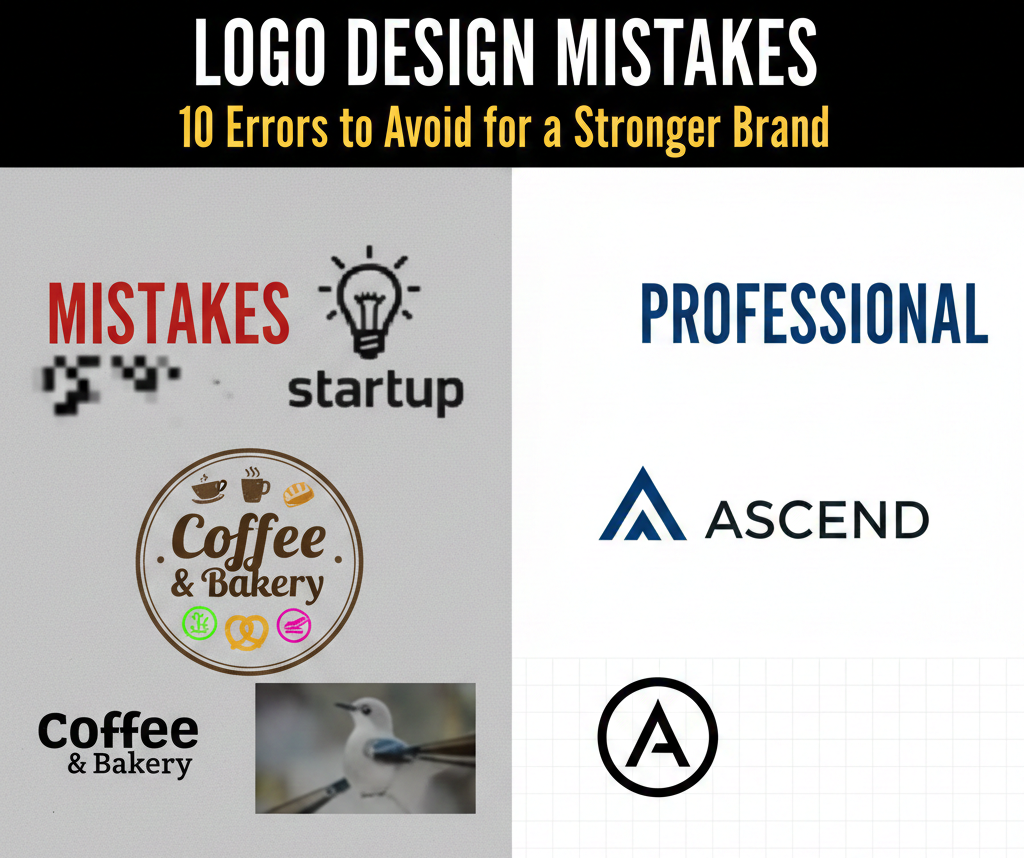
A hallmark of logo design mistakes is creating a logo in a raster format (like a JPEG or PNG) rather than a vector format.
Because raster images are made of pixels, they lose quality when scaled up for signage or billboards.
Professional logo design always utilizes vector software (like Adobe Illustrator), ensuring the logo remains crisp at any size. Avoiding this technical blunder prevents significant branding errors during the printing and production phases.
3. Overcomplicating the Visual Concept
Complexity is the enemy of recall.
Many businesses make logo design mistakes by trying to cram too many ideas into one symbol.
If a logo has intricate illustrations, four different fonts, and a complex color palette, it becomes unreadable at smaller sizes, such as on a favicon or a business card.
The goal of professional logo design is “simplicity with meaning.”
Think of iconic brands like Apple or Nike; their lack of complexity prevents branding errors and allows for instant global recognition.
4. Choosing the Wrong Typography
Typography can make or break a brand.
Common logo design mistakes include using overused fonts (like Comic Sans or Papyrus), using too many different fonts, or choosing a typeface that doesn’t align with the brand’s personality.
For instance, a law firm using a “bubbly” font would be a massive branding error.
Professional logo design involves selecting or creating typefaces that complement the icon and communicate the right tone—whether that is authority, playfulness, or innovation.
5. Poor Color Choice and Lack of Versatility
Color evokes emotion, but relying too heavily on it is one of the classic logo design mistakes.
A great logo must work in black and white first. If your design loses its meaning without its color gradient, it isn’t strong enough.
Furthermore, choosing colors that clash or fail to meet accessibility standards is a common branding error.
Professional logo design ensures the palette is versatile enough for digital screens, embroidery, and grayscale printing.
6. Neglecting the Target Audience
A logo isn’t for the business owner; it’s for the customer.
One of the most selfish logo design mistakes is designing based solely on personal preference rather than market research.
If your target demographic is corporate executives, but your logo looks like it belongs on a cereal box, you’ve committed a fundamental branding error.
Professional logo design starts with a deep dive into audience personas to ensure the visual language speaks directly to the intended user.
7. Using Stock Art or Clipart
Nothing screams “unprofessional” louder than a logo that features a piece of stock art seen on a hundred other websites.
Using non-original elements is one of the most dangerous logo design mistakes because it prevents you from trademarking your brand.
To avoid these branding errors, ensure your visual assets are custom-made.
Investing in professional logo design guarantees that your mark is unique, legally protectable, and distinct from your competitors.
8. Poor Spacing and Kerning
The “white space” around and within a logo is just as important as the lines themselves.
Many logo design mistakes involve poor kerning (the space between letters) or inconsistent padding.
If letters are too close, they blur together; if they are too far apart, the brand name becomes hard to read.
Professional logo design pays meticulous attention to mathematical grids and optical balance to ensure no branding errors occur in the layout’s geometry.
9. Designing for the Designer, Not the Brand
Sometimes, designers get carried away with “art” and forget about “utility.”
This leads to logo design mistakes where the logo looks beautiful in a portfolio but fails to function in the real world.
A logo must be functional across various media.
Professional logo design balances artistic flair with practical application, ensuring the brand avoids branding errors when the logo is placed on diverse backgrounds or different materials like glass, fabric, or metal.
10. Failing to Provide a Style Guide
The final mistake happens after the design is finished.
Even a perfect logo can be ruined by improper use. One of the most overlooked logo design mistakes is failing to create a Brand Style Guide.
Without rules on how to use the logo, employees might stretch the image, change the colors, or place it on distracting backgrounds.
These branding errors dilute brand equity. Professional logo design always concludes with a “Brand Bible” that dictates exactly how the logo should and should not be used.
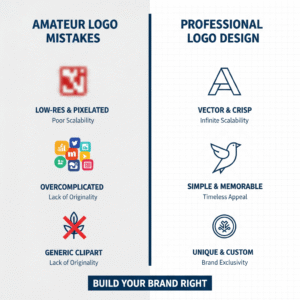
Comparison: Amateur vs. Professional Logo Design
| Feature | Amateur Design (Mistakes) | Professional Logo Design |
| Format | Raster (Pixelated) | Vector (Infinite Scale) |
| Uniqueness | Uses Stock/Clipart | 100% Original |
| Longevity | Follows Trends | Timeless Appeal |
| Versatility | Only works in color | Works in B&W and Color |
| Typography | Generic/Default Fonts | Custom/Curated Type |
Frequently Asked Questions
What are the most common logo design mistakes?
The most common mistakes include using raster images instead of vectors, overcomplicating the design, following short-lived trends, and choosing inappropriate typography that doesn’t match the brand’s voice.
How can I avoid branding errors in my new business?
The best way to avoid branding errors is to conduct thorough competitor research, define your target audience clearly, and hire a professional who understands the technical requirements of logo scalability and reproduction.
Why is professional logo design worth the investment?
Professional logo design ensures your brand is unique, legally protectable, and versatile. It prevents the need for an expensive rebrand a year down the line and builds immediate trust with your audience.
Conclusion: Future-Proofing Your Visual Identity
Avoiding logo design mistakes is about more than just “looking good,” it is about building a foundation for your company’s future.
By steering clear of branding errors like stock imagery, over-complexity, and poor font choices, you set your business up for long-term success.
In a digital-first world, your logo must work everywhere, from a tiny smartwatch screen to a massive digital billboard.
Investing in professional logo design is the most effective way to ensure your brand remains relevant, recognizable, and reputable for years to come.
Read our other articles:
The Critical Importance of Brand Identity for Modern Business
Top 10 Effective Branding Strategies For Startups in 2026
Top 7 Web Development Trends 2026 You Must-Know
Custom Website vs Template? The Ultimate 2026 Guide
SEO for Small Businesses: The Ultimate 2026 Growth Guide
10 Best Social Media Marketing Tips for Small Businesses
10 Critical Digital Transformation Benefits for Growth
Scaling Businesses with Tech: The Ultimate 2026 Guide
10 Pro Tips to Choose the Best Web Development Company
Website Redesign Checklist: The Ultimate 2026 Guide
Custom Web Development vs WordPress: Which Is Better?
SEO for Beginners: The Ultimate 2026 Strategy Guide