
Finding the perfect digital partner is no longer just about “getting a website online.”
In today’s hyper-competitive market, your choice of a web development company serves as the foundation for your brand’s digital identity, user experience, and long-term scalability.
Whether you are seeking enterprise solutions for a multinational corporation or looking for SaaS for startups to disrupt an industry, the stakes are high.
A wrong choice can lead to wasted capital and technical debt, while the right website development agency can propel your business to new heights.
Let’s see how to choose the right partner for your company to build enterprise solutions and SaaS for startups to drive your business growth.
1. Define Your Project Goals and Requirements
Before you even begin searching for a web development company, you must have a crystal-clear understanding of what you want to achieve.
Are you building a simple landing page, a complex e-commerce platform, or a custom internal tool?
- Identify your core features: Do you need third-party API integrations?
- Determine your budget: Quality development is an investment, not a cost.
- Establish a timeline: When does this project need to be live to meet your business milestones?
By defining these parameters early, you can filter through any website development agency list to find those that specialize in your specific niche.
2. Evaluate Technical Expertise and Portfolio
A reputable web development company should have a proven track record.
When reviewing their portfolio, don’t just look at the aesthetics; look at the functionality.
What to Look for in a Portfolio:
- Diversity of Work: Do they handle technology for growth across various industries?
- User Experience (UX): Are the sites intuitive and easy to navigate?
- Mobile Responsiveness: Does the site perform flawlessly on all devices?
High-end professional web developers will often showcase case studies that detail the problem they solved, the technology used, and the measurable results achieved for the client.
3. Check for Specialized Enterprise Solutions
If your business is scaling rapidly, you cannot settle for a “one size fits all” approach. You need a web development company that understands enterprise solutions.
Enterprise-level projects require:
- High-Level Security: Protection against data breaches and cyber threats.
- Scalability: The ability to handle thousands of concurrent users without a lag.
- Integration: Seamlessly connecting with CRM, ERP, and legacy systems.
A top-tier website development agency will prioritize these technical requirements to ensure your infrastructure grows alongside your revenue.
4. Assessing SaaS for Startups Experience
Startups have unique needs: speed-to-market, MVP (Minimum Viable Product) development, and iterative design.
If you are a founder, your chosen web development company must be agile.
When vetting professional web developers for a startup, ask:
- How do you handle feature prioritization?
- Can you assist with the deployment of SaaS for startups on cloud platforms like AWS or Azure?
- What is your approach to Lean development?
Choosing a partner that understands the startup ecosystem ensures that your technology for growth is flexible enough to pivot when the market demands it.
5. Analyze Communication and Cultural Fit
Technical skills are vital, but communication is the glue that holds a project together. A web development company should feel like an extension of your internal team.
| Feature | What to Look For |
| Response Time | Do they answer emails and calls promptly? |
| Project Management | Do they use tools like Jira, Trello, or Asana? |
| Transparency | Are they honest about potential risks or delays? |
| Passion | Do they seem genuinely interested in your business success? |
The best website development agency relationships are built on trust and a shared vision for the final product.
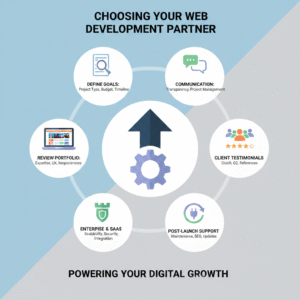
6. Review Client Testimonials and References
Social proof is the most reliable indicator of a web development company‘s reliability.
Beyond the testimonials on their own website, check third-party platforms like Clutch, G2, or Google Business Profiles.
Don’t be afraid to ask for direct references. Speaking with a past client of a website development agency can provide insights into:
- How they handle stress and tight deadlines.
- The quality of their post-launch support.
- Whether the professional web developers stayed within the initial budget.
7. Development Methodologies and Technology Stack
Does the web development company use Agile, Scrum, or Waterfall?
Most modern professional web developers prefer Agile, as it allows for regular feedback and adjustments throughout the build.
Furthermore, ensure they use modern technology for growth. You don’t want your site built on outdated frameworks that will be obsolete in two years. Ask about their proficiency in:
- Frontend: React, Vue.js, or Angular.
- Backend: Node.js, Python, or Go.
- Databases: PostgreSQL, MongoDB, or Redis.
8. Post-Launch Support and Maintenance
The launch of your website is just the beginning.
A professional web development company provides ongoing maintenance to ensure the site remains secure and functional.
Websites require:
- Regular security patches.
- Software and plugin updates.
- Performance monitoring and optimization.
Before signing a contract with a website development agency, clarify their support packages. Do they offer 24/7 monitoring? What is their hourly rate for future updates?
9. Pricing Models: Value vs. Cost
While price is always a factor, choosing a web development company based solely on the lowest bid is often a recipe for disaster.
Low-cost providers often cut corners on security, SEO, or code quality.
Common Pricing Structures:
- Fixed Price: Best for well-defined, small-scale projects.
- Time and Materials: Ideal for complex enterprise solutions where requirements may evolve.
- Retainer: Useful for ongoing development and support.
A great website development agency will be transparent about its pricing and provide a detailed breakdown of where your money is going.
10. The Role of SEO and Marketing Integration
What good is a beautiful website if no one can find it?
A forward-thinking web development company integrates SEO (Search Engine Optimization) and AEO (Answer Engine Optimization) into the code itself.
Professional web developers should ensure:
- Schema Markup: Helping search engines understand your content.
- Fast Loading Speeds: A critical ranking factor for Google.
- Semantic HTML: Improving accessibility and crawlability.
When your technology for growth is optimized for search engines from day one, you save thousands in future marketing costs.
Frequently Asked Questions (FAQs)
- How much does it cost to hire a professional web development company?
The cost of hiring a web development company varies significantly based on project complexity. A standard business website might range from $5,000 to $20,000, while complex enterprise solutions or custom SaaS for startups can exceed $50,000 to $100,000+. Factors influencing price include custom functionality, third-party integrations, and the expertise level of the professional web developers involved.
- How long does it take for a website development agency to finish a project?
A typical timeline for a website development agency ranges from 8 to 16 weeks.
- Discovery & Planning: 2–3 weeks
- Design Phase: 3–4 weeks
- Development & Coding: 4–8 weeks
- Testing & Launch: 1–2 weeks. For larger enterprise solutions, the timeline may be longer to ensure rigorous security testing and seamless system integration.
- Should I hire a freelance developer or a web development company?
While freelancers may be more budget-friendly for small tasks, a full-service web development company provides a multidisciplinary team. A website development agency typically includes project managers, UI/UX designers, professional web developers, and QA testers. This team-based approach is essential for building scalable technology for growth and ensuring your project doesn’t stall due to a single person’s availability.
- What is the difference between frontend and backend development?
When you hire a web development company, they will utilize different professional web developers for different layers of your site:
- Frontend: Everything the user sees and interacts with (layout, buttons, fonts).
- Backend: The “behind the scenes” logic (servers, databases, and APIs). A top-tier website development agency provides “Full Stack” expertise, ensuring both layers work in perfect harmony to support your business goals.
- Can a web development company help with SaaS for startups?
Yes, many agencies specialize specifically in SaaS for startups. This involves building multi-tenant architectures, subscription billing systems, and cloud-scalable infrastructure. Choosing a web development company with SaaS experience ensures that your technology for growth is built on a framework that can handle a rapidly expanding user base without needing a total rebuild.
Conclusion: Making the Final Decision
Choosing the right web development company is a strategic move that dictates your business’s digital trajectory.
By focusing on technical expertise, cultural fit, and a deep understanding of enterprise solutions or SaaS for startups, you set yourself up for long-term success.
Remember, your website is your most powerful salesperson. Don’t leave its development to chance. Partner with a website development agency that views your success as their own and utilizes the best professional web developers to build your future.
Read our other articles:
The Critical Importance of Brand Identity for Modern Business
Top 10 Effective Branding Strategies For Startups in 2026
Top 7 Web Development Trends 2026 You Must-Know
Custom Website vs Template? The Ultimate 2026 Guide
SEO for Small Businesses: The Ultimate 2026 Growth Guide