In today’s hyper-competitive digital landscape, your website is more than just an online brochure; it’s your 24/7 salesperson, your primary lead generation engine, and often, the very first impression potential customers have of your brand.
Business owners face a crucial decision when building a digital asset: do you opt for the speed and affordability of a pre-designed template website, or do you invest in a unique, tailor-made custom website?
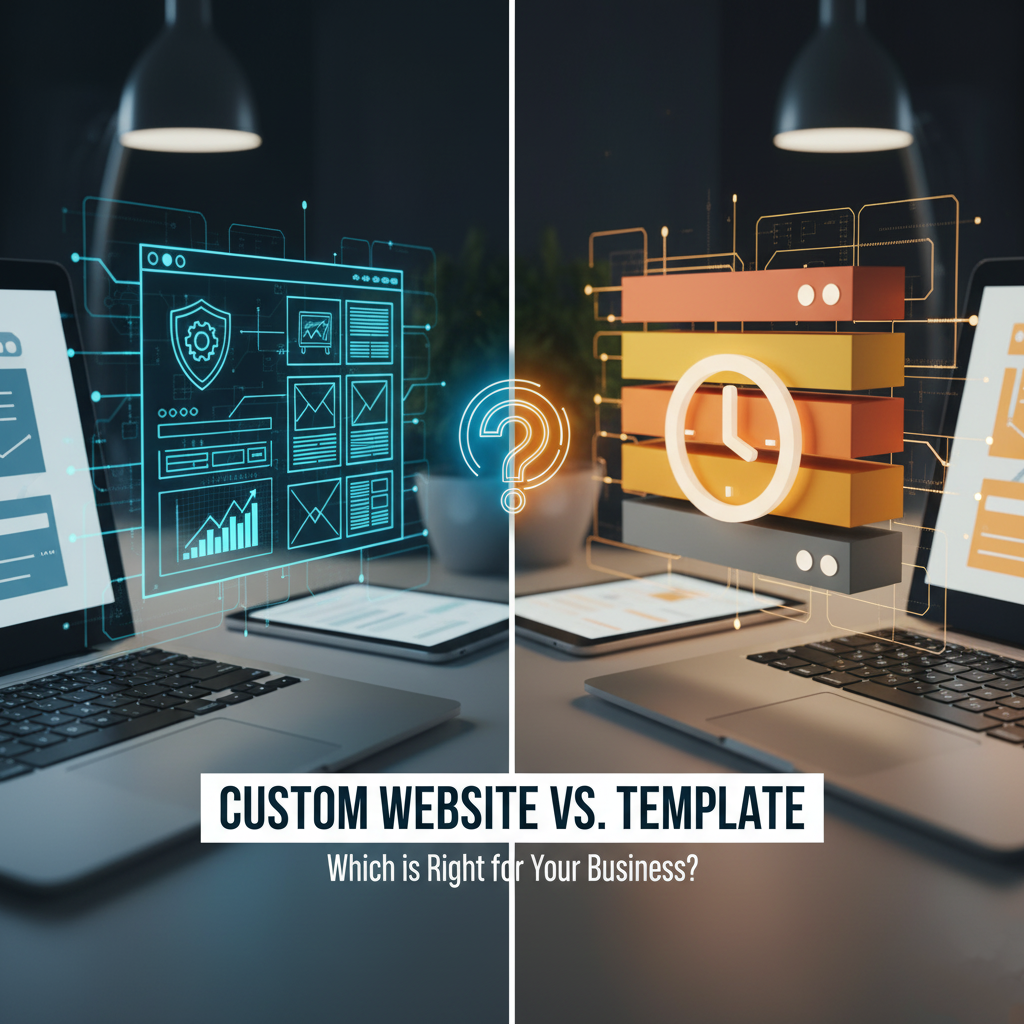
This is not a decision to be taken lightly. The choice between a custom website vs template will dictate your brand’s scalability, performance, long-term website design cost, and ability to rank against competitors.
This comprehensive guide will break down the pros and cons of each option, helping you determine the best website option for business growth in 2026 and beyond.
Let’s get started.
Direct Answer: Custom vs. Template?
If you need to launch in under two weeks on a budget of less than $3,000, a template is your best bet. However, if your goal is to dominate search rankings, provide a unique user journey, or scale complex features, a custom website is the superior investment for 2025. Custom sites offer a 40% higher potential for ranking in AI-driven search results (AEO) due to cleaner code and optimized site architecture.
Defining the Contenders: Template vs. Custom
To make an informed decision, let’s first clarify what separates these two (custom website vs template) fundamental approaches to web design.
Template Websites: The Quick-Start Solution
A template website is built using a pre-designed, ready-made theme or layout available on platforms like WordPress, Wix, Squarespace, or Shopify.
- How it Works: You select a layout from a library, input your content, swap in your logo and images, and you’re live quickly.
- Key Selling Point: Speed, ease of use, and low website design cost.
Custom Websites: The Bespoke Digital Asset
A custom website is designed and coded from the ground up by a team of professional web designers and developers.
- How it Works: The process begins with strategic planning and wireframing, with every element from the user interface (UI) to the functionality being built precisely for your unique business goals, branding, and target audience.
- Key Selling Point: Uniqueness, unlimited functionality, and scalability.
Template Website Benefits: The Case for Speed and Budget
Templates are popular for a reason. They offer compelling advantages, particularly for new businesses or those testing a concept.
| Pros of Template Websites | The Impact on Your Business |
| Low Upfront Cost | Ideal for startups or micro-businesses with a tight initial budget. Many themes are free or cost under $100. |
| Rapid Deployment | Launch your basic website in days or weeks, perfect if you need an immediate online presence. |
| User-Friendly | Drag-and-drop builders require little to no coding knowledge, making it a viable DIY option. |
| Built-in Features | Many premium templates come with essential features like contact forms, basic SEO tools, and galleries pre-installed. |
The Crucial Trade-Offs: Limitations of Templates
While the low initial website design cost is appealing, the long-term limitations of templates can quickly become roadblocks to growth, making them a costly compromise. This is a core part of the web design comparison.
| Cons of Template Websites | Long-Term Business Impact |
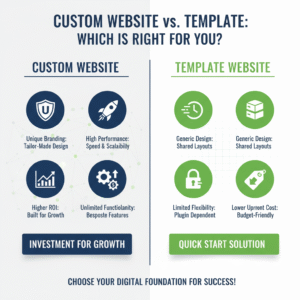
| Generic Design | Your site will share its layout with thousands of others. This lack of unique branding hinders differentiation and brand recall. |
| Limited Scalability & Flexibility | You are restricted to the theme’s structure. Adding complex or custom features (like unique calculators, custom CRMs, or advanced filtering) often requires expensive, performance-slowing plugins or a full redesign. |
| Performance Issues | Templates are often bloated with unnecessary code to accommodate various uses, leading to slower load times, which hurts both user experience and crucial SEO rankings. |
| Security Risks | Reliance on numerous third-party plugins (to force template functionality) increases potential security vulnerabilities. |
Custom Website Advantages: Built for Growth and Conversion
If your website is an indispensable engine for lead generation and revenue, the pros and cons of custom websites weigh heavily in favor of the former.
A custom build is a strategic business asset designed for maximum return on investment (ROI).
| Pros of Custom Websites | The Impact on Your Business |
| 100% Unique Branding | Every pixel is designed to reflect your brand identity. You stand out immediately, building credibility and trust. |
| Superior Performance & Speed | Built with clean, lean code, custom sites are significantly faster and more stable, directly improving user experience and technical SEO. |
| Unlimited Scalability | The website is built on a flexible foundation, allowing you to easily add new features, integrations, and complex functionality as your business evolves. It grows with you. |
| Optimized for Conversion | The user journey is intentionally mapped out and designed to drive specific actions (e.g., calls, quotes, sales) based on your unique audience data. |
| Built-in SEO Foundation | Technical SEO best practices (clean code, structure, mobile-first design) are baked into the core, not bolted on as an afterthought. |
The Initial Hurdles: Cons of Custom Development
The primary deterrents for businesses considering the pros and cons of custom websites are typically the initial investment.
| Cons of Custom Websites | The Initial Commitment |
| Higher Upfront Investment | The website design cost is significantly higher because you are paying for strategy, design, and bespoke development. |
| Longer Time to Launch | The process from discovery to design, development, and testing takes weeks or months, not days. |
| Requires Expert Developers | You need to hire a skilled agency or professional development team; this is not a DIY project. |
A Deep Dive: Critical Comparison Factors
The custom website vs template debate hinges on a few key business metrics.
1. Cost: Initial Expense vs. Long-Term ROI
- Template: Low initial cost. However, hidden fees for premium themes, necessary plugins, and eventual forced redesigns can make the website design cost accumulate over time, leading to poor ROI.
- Custom: High initial investment. This cost, however, is an investment in a highly-optimized, scalable asset that is built to convert and perform for years. The long-term ROI is typically far superior due to higher conversion rates and lower maintenance/re-development costs.
2. SEO and Search Visibility (SEO, AEO, & GEO)
In 2026, an SEO-optimized website is non-negotiable. With the rise of AI in search (Generative Engine Optimization or GEO) and a focus on direct answers (Answer Engine Optimization or AEO), your site’s technical health is more important than ever.
- Template: Can be okay for basic SEO, but often hindered by bloated code, slow speeds, and structural rigidity that makes advanced technical SEO implementation (like custom schema markup or specific core web vital improvements) difficult. Your chances of getting a Featured Snippet (AEO) or being cited by Google SGE (GEO) are lower if the underlying code is messy or slow.
- Custom: The Best Website Option for Business, focused on growth. Developers can guarantee clean, fast code, implement advanced schema markup for AEO (FAQ, How-To, Product Schema), and structure the content semantically, significantly improving your E-E-A-T (Experience, Expertise, Authoritativeness, Trust) signals for both traditional SEO and the new era of GEO.
3. Scalability and Functionality
- Template: When you need a new feature, you must find a pre-existing plugin and hope it integrates well with your theme, often resulting in performance decay. This creates a ceiling for your business’s online capabilities.
- Custom: Scalability is built-in. If your business requires a new booking engine, a sophisticated product configurator, or integration with a new CRM, the custom framework is designed to handle new features seamlessly without breaking the existing structure.
Decision Framework: Which Path Is the Best Website Option for Business?
The right choice depends entirely on your business’s current stage, budget, and long-term ambition. Use the table below as a quick guide in your custom website vs template web design comparison.
| Choose a Template Website If… | Choose a Custom Website If… |
| Budget: You have a minimal budget ($\$500 – \$5,000$). | Budget: You can invest a significant budget ($\$10,000+$) for a high-performing asset. |
| Goals: You need a simple online presence or a temporary landing page to validate a concept. | Goals: Your website is your primary source of leads, sales, or customer interaction. |
| Functionality: Your needs are extremely basic (e.g., a simple blog, a five-page informational site). | Functionality: You require unique features, complex integrations, or advanced customer portals. |
| Growth: You are a sole proprietor or a startup with a narrow local focus and minimal long-term online growth plans. | Growth: You plan to scale your business, expand your services, and dominate your niche in the market. |
| Time: You need to launch in less than one month. | Time: You have 8-16 weeks for a structured, strategic development process. |
Frequently Asked Questions (FAQs)
To further assist business owners in their decision-making process about choosing a custom website vs template, here are answers to common queries:
Q: What are the main pros and cons of custom websites for an e-commerce business?
A: The main pros and cons of custom websites for e-commerce are that they offer unlimited product catalog flexibility, custom checkout funnels designed for maximum conversion, and superior speed (pros); however, they demand a higher initial website design cost and a longer development timeline (cons). For e-commerce, the higher initial investment almost always pays off through superior performance and a unique shopping experience.
Q: Is a template website really bad for SEO in the long run?
A: A template website isn’t inherently “bad” for SEO, but it is often limited. Its generic code can be slower and less flexible, making it difficult to achieve top-tier technical SEO performance, especially when compared to a lightning-fast, clean-coded custom website. This lack of technical perfection makes it harder to compete for competitive keywords, rich snippets (AEO), and inclusion in AI-generated answers (GEO).
Q: How much more expensive is a custom website compared to a template website?
A: On average, a professional, full-service custom website for a small to medium-sized business will cost anywhere from 5 to 10 times more than a premium template and associated fees. While a template might range from $500 to $5,000 (including software and small fees), a custom build can start at $10,000 and go up depending on complexity and functionality.
Q: Can I switch from a template to a custom site later?
A: Yes, many businesses start with a template like Squarespace or Elementor to prove their concept. Once revenue grows, they migrate to a custom-built solution to improve scalability and SEO performance.
Q: Why are template websites often slower?
A: Template websites are built with “code bloat.” Because they are designed to be flexible for everyone, they include CSS and JavaScript files for features you might not even use, which increases page load times.
Q: Is a custom website better for SEO than a template?
A: Yes. Custom websites typically rank higher because they are built with cleaner code, which improves site speed and mobile responsiveness—two critical Google ranking factors. They also allow for better implementation of Schema markup, making it easier for AI search engines to index and cite your content.
Conclusion: Investing in Your Digital Future
The choice between a custom website vs template is ultimately a reflection of your business vision. For the budget-conscious startup that just needs a digital presence now, a template is a viable, short-term solution. It offers a low entry point and high speed.
However, for the business owner seeking sustainable growth, unmatched brand authority, and a digital asset built to be a high-performance, conversion-focused machine, the investment in a custom website is non-negotiable.
A template provides you with a borrowed vehicle; a custom website provides you with a purpose-built, high-octane race car engineered for the long haul. Choose the best website option for business that aligns with where you intend to be five years from now.
In 2026, betting on a unique, scalable, and technically superior custom build is the smartest strategic move for any company serious about standing out and growing online.
Ready to discuss your unique needs? Let’s engineer your custom digital foundation for the future.
Contact us today for a free custom website consultation and a detailed web design comparison based on your specific business goals.
Read our other articles:
The Critical Importance of Brand Identity for Modern Business
Top 10 Effective Branding Strategies For Startups in 2026
Top 7 Web Development Trends 2026 You Must-Know
Custom Website vs Template? The Ultimate 2026 Guide
SEO for Small Businesses: The Ultimate 2026 Growth Guide
10 Best Social Media Marketing Tips for Small Businesses
10 Critical Digital Transformation Benefits for Growth