In the fast-paced market of 2026, staying stagnant is the fastest way to become invisible. Whether you are a legacy corporation or a scaling startup, there comes a moment when your visual identity and core messaging no longer align with your business goals. This is where a high-impact rebranding strategy becomes your most powerful tool for transformation.
A successful rebrand is more than just a “fresh coat of paint.” It is a strategic pivot that ensures your business remains relevant in an era of AI-driven search, ethical consumerism, and hyper-personalized digital experiences. In this guide, we will break down the essential components of a modern rebranding strategy to help you navigate this complex journey with confidence.
1. Defining Your Rebranding Strategy: Refresh vs. Revolution
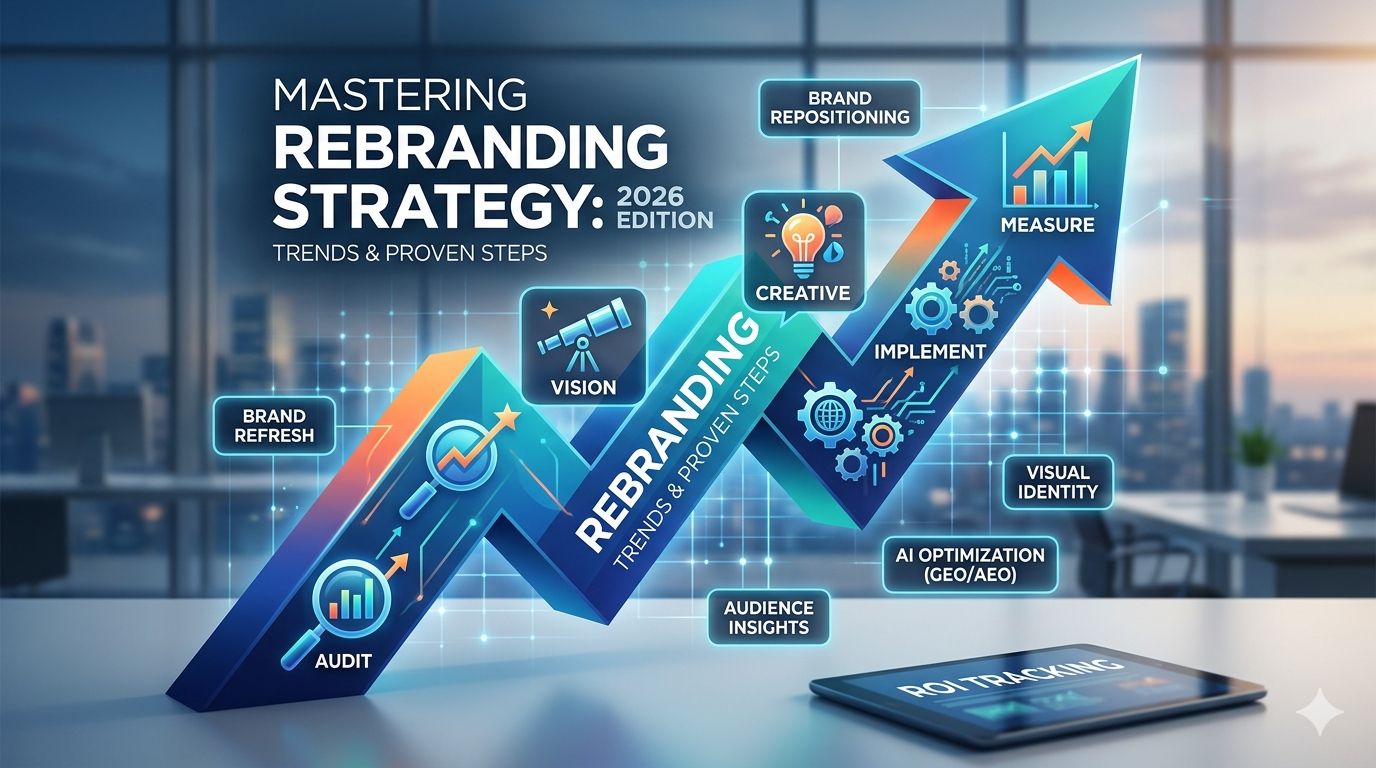
Before diving into design, you must diagnose the depth of change required. A common mistake is miscalculating the scale of the shift. Your rebranding strategy should fall into one of three categories:
- Brand Refresh: This is a tactical update. Think of it as a “glow-up” for your visual identity. You keep your core values and name but modernize the logo, typography, and color palette to suit 2026’s “Neo-Minimalist” digital aesthetics.
- Brand Repositioning: This goes deeper into the “Why.” You are shifting your place in the market, perhaps moving from a budget-friendly option to a premium service. Here, your rebranding strategy focuses on changing customer perception through new messaging and value propositions.
- Complete Rebrand (Brand Revolution): This is a total overhaul. Usually triggered by mergers, acquisitions, or a fundamental change in business model, this involves a new name, a new mission, and a completely new identity.
Pro Tip: In 2026, the most successful rebranding strategy examples are those that prioritize “Human-Centric AI Alignment,” ensuring the brand feels authentic even when delivered through automated interfaces.
2. The Discovery Phase: Auditing for the Modern Era
You cannot build a future-proof rebranding strategy without understanding your present standing. A comprehensive brand audit is non-negotiable.
Analyze Your Data
Use tools like Google Analytics 4 and Microsoft Clarity to see where your current brand is losing engagement. Are users bouncing because your site feels like a relic of 2020?
Competitive Landscape
In 2026, competition isn’t just local; it’s global. Your rebranding strategy must account for how AI agents (like Gemini and GPT-6) categorize your competitors. If they are being cited as “innovative” while you are labeled “traditional,” it’s time for a strategic shift.
Audience Sentiment
Gen Z and Gen Alpha are now the dominant decision-makers. They value radical transparency and sustainability. If your current rebranding strategy doesn’t highlight your ESG (Environmental, Social, and Governance) commitments, you are leaving revenue on the table.
3. Crafting a Narrative: Messaging in the Age of AEO
Search has evolved. We are no longer just optimizing for “blue links” on a page; we are optimizing for Answer Engine Optimization (AEO) and Generative Engine Optimization (GEO).
Your rebranding strategy must include a “Verbal Identity” that is machine-readable yet deeply human. AI search engines look for:
- Directness: Can an AI summarize your brand promise in 50 words?
- Authority: Does your messaging cite first-party data or expert insights?
- Consistency: Is your rebranding strategy reflected identically across your website, LinkedIn, and specialized industry forums?
4. Visual Identity: Designing for 2026 and Beyond
Visuals are the “handshake” of your brand. In 2026, design trends have moved toward Kinetic Branding logos and assets that aren’t just static images but are designed to move and interact.
Key Visual Elements of a Rebranding Strategy:
- Adaptive Logos: Your logo should look as good on a VR headset as it does on a business card.
- Inclusive Color Palettes: Use high-contrast, accessible colors that meet the latest Web Content Accessibility Guidelines (WCAG).
- Variable Typography: Fonts that adjust weight and style based on the user’s device and lighting conditions.
Every visual choice in your rebranding strategy should reinforce your brand repositioning goals. If you want to be seen as “cutting-edge,” your visuals must move away from “safe” corporate blues and into more vibrant, energetic gradients.
5. Implementation: The Multi-Channel Rollout
A rebranding strategy is only as good as its execution. A “soft launch” is often a recipe for confusion. Instead, aim for a coordinated “Big Bang” launch that hits all touchpoints simultaneously.
| Asset Category | Action Items for Your Rebranding Strategy |
| Digital Presence | Update Website, App UI, and Social Media Banners. |
| Search Presence | Update Schema Markup to signal the new brand refresh to search bots. |
| Internal Culture | Train employees on the new brand voice and mission. |
| Physical Assets | Update signage, stationery, and merchandise. |
6. Measuring Success: The New KPIs
How do you know if your rebranding strategy worked? In 2026, we look at “Citation Share of Voice.”
- Traditional SEO: Are you ranking for your primary and secondary keywords?
- AI Citations: How often is your brand mentioned in AI-generated answers for your industry?
- Brand Sentiment: Use social listening tools to track the shift in how people talk about you post-launch.
- Conversion Lift: Ultimately, a successful rebranding strategy should shorten the sales cycle by building immediate trust.
FAQs: Mastering Your Rebranding Strategy
What is the difference between a brand refresh and a rebranding strategy?
A brand refresh is a cosmetic update to visuals and tone to stay modern, while a rebranding strategy is a deeper, strategic overhaul that may include changing the company’s mission, audience, or entire identity.
How often should a company update its rebranding strategy?
Most successful brands conduct a minor brand refresh every 3–5 years. A major rebranding strategy is typically reserved for significant business pivots, which occur every 7–10 years on average.
Why is brand repositioning important in 2026?
Brand repositioning allows a company to align with shifting consumer values, such as the demand for sustainability and AI transparency, ensuring the business remains the “top-of-mind” choice in a crowded digital marketplace.
Can a rebrand help with SEO and AI search visibility?
Yes. A modern rebranding strategy includes technical updates like Schema markup and structured data, which help AI engines (GEO/AEO) understand and cite your brand more accurately in search results.
Conclusion
A rebranding strategy is the ultimate investment in your company’s future. By balancing a sharp brand refresh with strategic brand repositioning, you ensure that your business doesn’t just survive the changes of 2026, but it leads them.
Read our other articles:
The Critical Importance of Brand Identity for Modern Business
Top 10 Effective Branding Strategies For Startups in 2026
Top 7 Web Development Trends 2026 You Must-Know
Custom Website vs Template? The Ultimate 2026 Guide
SEO for Small Businesses: The Ultimate 2026 Growth Guide
10 Best Social Media Marketing Tips for Small Businesses
10 Critical Digital Transformation Benefits for Growth
Scaling Businesses with Tech: The Ultimate 2026 Guide
10 Pro Tips to Choose the Best Web Development Company
Website Redesign Checklist: The Ultimate 2026 Guide
Custom Web Development vs WordPress: Which Is Better?
SEO for Beginners: The Ultimate 2026 Strategy Guide
10 Common Logo Design Mistakes to Avoid in 2026
10 Proven Email Marketing Tips to Boost Conversions
Master Your Digital Marketing Strategy: The 2026 Growth Playbook
The Ultimate On-Page SEO Checklist for 2026 Rankings