
In today’s hyper-competitive landscape, the traditional “grind” is no longer enough to achieve exponential growth.
For modern startups and SMEs, scaling businesses with tech has transitioned from a luxury to a fundamental necessity. We are no longer just using computers to do manual tasks faster; we are leveraging ecosystems of intelligence to replace bottlenecks with bridges.
Scaling isn’t just about getting bigger; it’s about increasing revenue while keeping costs relatively flat. This is where business growth with technology becomes the ultimate lever.
Without a digital backbone, your operations will eventually buckle under the weight of your own success.
Why Scaling Businesses with Tech is Non-Negotiable?
When we look at the trajectory of successful unicorns, a common thread emerges: they didn’t just hire more people; they deployed technology for growth.
- Eliminating Manual Friction: Human error is the silent killer of scale. By scaling businesses with tech, you automate the mundane, allowing your talent to focus on high-value strategy.
- Data-Driven Decisiveness: You can’t scale what you can’t measure. Modern enterprise solutions provide real-time analytics that move you from “guessing” to “knowing.”
- Global Accessibility: Cloud-based SaaS for startups allows a team in Austin to serve a client in Auckland without missing a beat.
Essential Software for Scaling Startups
The foundation of scaling businesses with tech begins with your “stack.” If your tools don’t talk to each other, you’re creating digital silos that will eventually crash.
1. CRM and Customer Success
To maintain business growth with technology, you need a centralized “source of truth” for customer data. Tools like Salesforce or HubSpot are no longer optional; they are the command centers for your revenue operations.
2. Financial Automation
Scaling creates complexity in billing. Implementing software for scaling startups like Stripe or NetSuite ensures that as your customer base grows by 10x, your accounting team doesn’t have to grow by 10x.
3. Project Management and Collaboration
As teams decentralize, technology for growth must include robust platforms like Monday.com or Asana. These tools ensure that “scale” doesn’t lead to “chaos.”
Leveraging SaaS for Startups to Drive Efficiency
The beauty of the current era is that you don’t need a million-dollar server room to begin scaling businesses with tech. The “as-a-service” model allows you to pay for exactly what you need, when you need it.
Using SaaS for startups provides:
- Elasticity: Scale your seat count up or down instantly.
- Security: Benefit from enterprise-grade security protocols without the enterprise-grade price tag.
- Integration: Most modern SaaS tools offer API connectivity, ensuring your tech stack remains fluid.
If you are serious about business growth with technology, your first move should be auditing your current manual processes and finding a SaaS equivalent.
The Role of Enterprise Solutions in Long-Term Scale
While startups often start with lean tools, reaching the mid-market or corporate level requires enterprise solutions. Scaling businesses with tech at this level involves more than just “apps,” it involves “ecosystems.”
- ERP (Enterprise Resource Planning): Unifying HR, Finance, and Supply Chain.
- Business Intelligence (BI): Turning raw data into predictive insights.
- Custom API Development: Building proprietary bridges between your unique business logic and third-party tools.
Sustainable business growth with technology requires a roadmap that transitions from “off-the-shelf” fixes to integrated enterprise architectures.
Overcoming the Challenges of Scaling Businesses with Tech
It isn’t all smooth sailing. When scaling businesses with tech, companies often run into “Technical Debt.” This happens when you choose a quick, cheap software fix today that becomes a massive roadblock tomorrow.
| Challenge | Solution for Scaling Businesses with Tech |
| Tool Fatigue | Consolidate your stack; prioritize “All-in-One” platforms. |
| Data Security | Invest in SOC2-compliant software for scaling startups. |
| User Adoption | Prioritize UX; if the team won’t use it, the tech is useless. |
By focusing on technology for growth that is intuitive and integrated, you bypass the friction that kills most scaling attempts.
The Future: AI and Scaling Businesses with Tech
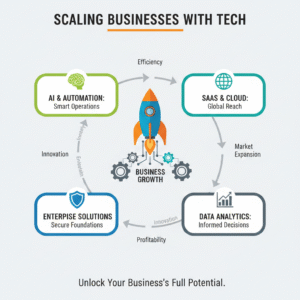
We cannot discuss scaling businesses with tech in 2026 without mentioning Artificial Intelligence. AI is no longer a buzzword; it is the engine of business growth with technology.
- Predictive Scaling: AI can forecast when your servers or staff will hit capacity before it happens.
- Automated Customer Service: Generative AI handles 80% of Tier-1 support, allowing for infinite scale without hiring a massive call center.
- Hyper-Personalization: Using SaaS for startups that utilize machine learning to deliver individual experiences to millions of users simultaneously.
Summary of Best Practices
To succeed in scaling businesses with tech, follow this checklist:
- Audit Regularly: Is your current software for scaling startups still serving your size?
- Prioritize Integrations: Never buy a tool that doesn’t have an open API.
- Invest in Training: Technology for growth is only as good as the people operating it.
- Watch Your Margins: Use enterprise solutions to reduce COGS (Cost of Goods Sold).
Frequently Asked Questions (FAQs)
Q: What is the difference between business growth and scaling businesses with tech?
A: While the terms are often used interchangeably, they are fundamentally different. Growth refers to increasing revenue at the same rate you add resources (e.g., hiring 10 new people to handle 10 new clients). Scaling businesses with tech involves increasing revenue exponentially while only increasing costs incrementally. Technology acts as the multiplier that allows you to handle a massive influx of work without a 1:1 increase in headcount.
Q: How does business growth with technology improve profit margins?
A: Business growth with technology improves margins by reducing operational drag. Automation eliminates repetitive manual tasks, cloud computing removes the need for expensive physical infrastructure, and AI-driven analytics help prevent costly mistakes. When your “cost-to-serve” remains stable while your customer base grows, your profitability surges.
Q: What is the most important software for scaling startups?
A: The most important software for scaling startups is a robust, integrated CRM (Customer Relationship Management) system like HubSpot or Salesforce. A CRM acts as the “brain” of your company, ensuring that as you scale, no lead is dropped, and every customer interaction is documented and searchable. Following this, financial automation and project management tools are critical for maintaining order.
Q: When should a company move from basic apps to enterprise solutions?
A: You should transition to enterprise solutions when your current “off-the-shelf” tools start creating “data silos” or when you spend more time moving data between apps than actually working. If your business requires complex multi-departmental integration, advanced security compliance (like SOC2), or global multi-currency support, it’s time to invest in enterprise-grade architecture.
Q: What are the biggest risks when scaling businesses with tech?
A: The primary risk is “Technical Debt,” choosing cheap, non-scalable technology for growth that eventually breaks under high volume. Other risks include poor user adoption (buying software your team hates) and security vulnerabilities. To mitigate these, always choose SaaS for startups that offer high integration capabilities and enterprise-grade security protocols from day one.
Conclusion
Scaling businesses with tech is a journey, not a destination. As you move from a small team to a market leader, your relationship with technology will evolve from “helpful tools” to the “very fabric of your organization.”
By strategically choosing the right software for scaling startups and embracing enterprise solutions, you ensure that your growth is not just fast but sustainable.
The question isn’t whether you should be scaling businesses with tech, but how fast you can start.
Read our other articles:
The Critical Importance of Brand Identity for Modern Business
Top 10 Effective Branding Strategies For Startups in 2026
Top 7 Web Development Trends 2026 You Must-Know
Custom Website vs Template? The Ultimate 2026 Guide
SEO for Small Businesses: The Ultimate 2026 Growth Guide