Search Engine Optimization can feel like a secret language, but it’s actually the most powerful tool in your digital arsenal.
If you want your website to be found by the right people without paying for every click, understanding SEO for beginners is the first step toward online success.
In this comprehensive guide, I will break down the complexities of search algorithms into actionable steps.
Whether you are a small business owner, a budding blogger, or a marketing student, this basic SEO guide will provide the foundation you need to rank higher and stay there.
Let’s get started without further ado.
What is SEO for Beginners?
At its core, SEO for beginners is the process of improving your website to increase its visibility when people search for products or services related to your business in Google, Bing, and other search engines.
The goal is simple: to show up as high as possible in the organic (non-paid) search results. To do this, you need to understand how SEO works.
Search engines use “bots” to crawl pages on the web, going from site to site, collecting information about those pages, and putting them in an index. Algorithms then analyze pages in the index, taking into account hundreds of ranking signals to determine the order in which pages should appear in the search results for a given query.
Why SEO Matters in 2026?
With the rise of Generative AI and Answer Engine Optimization (AEO), the way people find information is changing. However, the fundamentals of SEO for beginners remain the same: providing high-quality, relevant content that answers the user’s intent.
How SEO Works: The Three Pillars
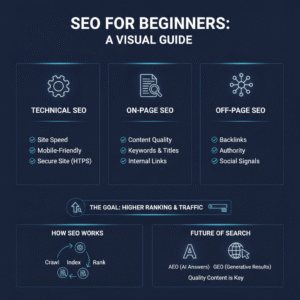
To truly grasp how SEO works, you need to look at it through three specific lenses. In any basic SEO guide, these are referred to as Technical, On-Page, and Off-Page SEO.
1. Technical SEO
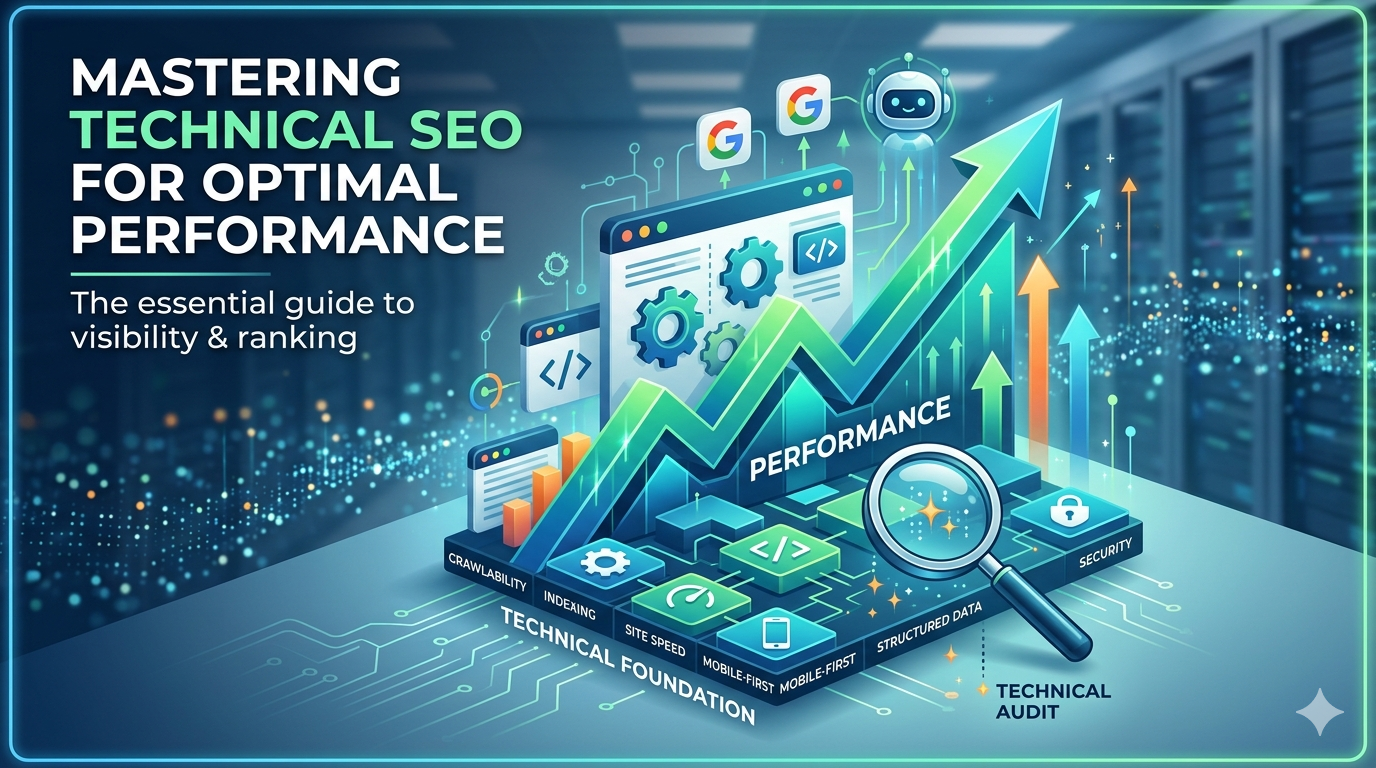
This is the “under the hood” part of SEO for beginners. It ensures that search engines can find, crawl, and index your content.
- Site Speed: Users expect pages to load in under two seconds.
- Mobile-Friendliness: Most searches now happen on mobile devices.
- Secure Connection (HTTPS): Google prioritizes secure websites.
2. On-Page SEO
This involves optimizing the content on your actual pages.
When practicing SEO for beginners, this is where you have the most control. It includes optimizing your headlines, HTML tags (title, meta, and header), and images.
3. Off-Page SEO
This refers to actions taken outside of your own website to impact your rankings within search engine results pages (SERPs).
The most important factor here is backlinks. When other reputable sites link to yours, it acts as a “vote of confidence.”
Keyword Research: The Foundation of SEO for Beginners
You cannot rank if you don’t know what people are searching for.
Keyword research is the most critical part of any basic SEO guide. It involves identifying the terms and phrases (queries) that your target audience uses.
How to Find Your Keywords
- Brainstorm Topics: Start with broad categories related to your business.
- Use Tools: Utilize tools like Google Keyword Planner, Ahrefs, or Semrush to find volume and competition.
- Analyze Intent: Ensure your keyword matches the search intent. For example, if someone searches “how to do SEO,” they want a guide (informational), not a service page (transactional).
When implementing SEO for beginners, focus on “long-tail keywords.” These are longer, more specific phrases that are easier to rank for and often have a higher conversion rate.
| Keyword Type | Example | Competition |
| Seed Keyword | SEO | Very High |
| Secondary Keyword | Basic SEO Guide | Medium |
| Long-tail Keyword | SEO for beginners in 2026 | Low |
Content is King: Writing for Humans and Bots
The secret to how SEO works in the age of AI (GEO and AEO) is quality.
Google’s E-E-A-T (Experience, Expertise, Authoritativeness, and Trustworthiness) guidelines are more important than ever.
Optimizing Your Content
When writing for SEO for beginners, follow these rules:
- Use the Primary Keyword Early: Include “SEO for beginners” in your first paragraph and H1 tag.
- Readability: Use short sentences and paragraphs. Use bullet points to break up text.
- Internal Linking: Link to other relevant posts on your site to keep users engaged and help bots navigate.
- External Linking: Link to high-authority sources to back up your claims.
Remember, a basic SEO guide shouldn’t just tell you to “stuff” keywords. It should teach you to provide value.
If a user lands on your page and immediately leaves (a “bounce”), search engines will realize your content isn’t helpful and lower your ranking.
On-Page Optimization Checklist
If you are new to SEO for beginners, use this checklist for every page you publish to ensure you are following the best basic SEO guide practices:
- Title Tag: Keep it under 60 characters and include your primary keyword.
- Meta Description: Write a compelling summary (under 160 characters) that encourages clicks.
- Header Tags (H1, H2, H3): Use these to structure your content logically.
- Image Alt Text: Describe your images for screen readers and search bots.
- URL Structure: Keep URLs short and descriptive (e.g., yoursite.com/seo-for-beginners).
By mastering these small details, you significantly improve how SEO works for your specific website.
Understanding Search Engine Algorithms (GEO & AEO)
The landscape of search is evolving. While traditional SEO for beginners focused on blue links on a page, we now have:
- AEO (Answer Engine Optimization): Optimizing content so AI assistants (like Alexa, Siri, or Gemini) can provide your content as a direct answer.
- GEO (Generative Engine Optimization): Ensuring your content is cited by AI-powered search results like Google’s Search Generative Experience (SGE).
To succeed in these areas, your basic SEO guide strategy must include structured data (Schema markup).
A schema is a code you add to your website that helps search engines provide more informative results for users. It’s a vital part of understanding how SEO works in a modern, AI-driven world.
Measuring Success in SEO for Beginners
You can’t improve what you don’t measure. As you implement these SEO for beginners strategies, you need to track your progress.
Key Metrics to Track
- Organic Traffic: How many people are finding you through search?
- Keyword Rankings: Where do you stand for your target terms like “basic SEO guide“?
- Click-Through Rate (CTR): What percentage of people who see your link actually click it?
- Backlinks: How many new sites are linking to you?
Tools like Google Search Console and Google Analytics are essential and free. They provide the data you need to see exactly how SEO works for your specific niche and where you can improve.
Common Mistakes to Avoid
Even with a basic SEO guide, it’s easy to fall into traps. When starting with SEO for beginners, avoid these pitfalls:
- Keyword Stuffing: Don’t force your keywords. If it doesn’t sound natural, don’t use it.
- Buying Backlinks: This can get your site penalized or even banned from Google.
- Ignoring Local SEO: If you have a physical location, ensure your Google Business Profile is optimized.
- Slow Page Load: Don’t let heavy images ruin your user experience.
Frequently Asked Questions
- How long does it take for SEO for beginners to show results?
SEO is a long-term strategy. Generally, it takes anywhere from 3 to 6 months to start seeing significant movement in rankings. Because search engines need time to crawl your site and build trust in your content, consistency is more important than speed.
- Can I do SEO on my own, or do I need an expert?
You can absolutely start with SEO for beginners on your own. Most website platforms (like WordPress, Wix, or Shopify) have built-in tools that make following a basic SEO guide much easier. However, as your site grows, you might consider an expert for complex technical audits or advanced link-building strategies.
- What is the most important factor in how SEO works?
While there are over 200 ranking signals, the most important factor is relevance and quality. Google’s primary goal is to provide the best possible answer to a user’s query. If your content is helpful, well-structured, and authoritative, you are already winning at SEO for beginners.
- Are keywords still relevant in 2026?
Yes, but the way we use them has changed. In the past, people practiced “keyword stuffing.” Today, SEO for beginners focuses on “topics” and “entities.” You should include your primary keyword naturally, but you must also include related terms (LSI keywords) to show search engines that you have a deep understanding of the subject.
- What is the difference between On-Page and Off-Page SEO?
- On-Page SEO: Factors you control on your own site (content, meta tags, site speed).
- Off-Page SEO: Factors that happen away from your site (backlinks, social media mentions, brand authority).
A successful basic SEO guide must balance both to prove to search engines that your site is both relevant and popular.
- How does AI impact SEO for beginners?
AI tools like ChatGPT or Gemini can help you brainstorm topics, but search engines now prioritize “Human-First” content. To rank well, ensure your content has a unique perspective or original data that AI cannot easily replicate. This is a core part of modern how SEO works—balancing automation with human expertise.
- Does social media affect my SEO rankings?
Social media does not directly contribute to SEO rankings. However, social media helps distribute your content, which leads to more eyes on your page, more brand searches, and a higher likelihood of earning backlinks—all of which are vital for SEO for beginners.
- Is SEO a one-time task?
No. Because search engine algorithms and competitor content are constantly changing, you must treat your basic SEO guide as a living document. Regularly updating old posts and monitoring your “Search Console” is essential to maintaining your rankings.
Conclusion: Your Journey Starts Here
Mastering SEO for beginners is a marathon, not a sprint. It takes time for search engines to recognize your authority and reward you with high rankings.
However, by following this basic SEO guide and consistently producing high-quality content, you will build a sustainable source of traffic that grows over time.
Understanding how SEO works is the first step toward digital independence. Start by optimizing one page at a time, monitor your results, and stay curious as the industry evolves.
Read our other articles:
The Critical Importance of Brand Identity for Modern Business
Top 10 Effective Branding Strategies For Startups in 2026
Top 7 Web Development Trends 2026 You Must-Know
Custom Website vs Template? The Ultimate 2026 Guide
SEO for Small Businesses: The Ultimate 2026 Growth Guide
10 Best Social Media Marketing Tips for Small Businesses
10 Critical Digital Transformation Benefits for Growth
Scaling Businesses with Tech: The Ultimate 2026 Guide
10 Pro Tips to Choose the Best Web Development Company
Website Redesign Checklist: The Ultimate 2026 Guide
Custom Web Development vs WordPress: Which Is Better?