In a digital marketplace crowded with endless scrolling, pop-up ads, and fierce competition, how does a business grab attention in less than a second? The answer isn’t a louder sales pitch; it’s an immediate, unforgettable visual identity.
Understanding visual branding importance is no longer just a luxury reserved for multinational corporations.
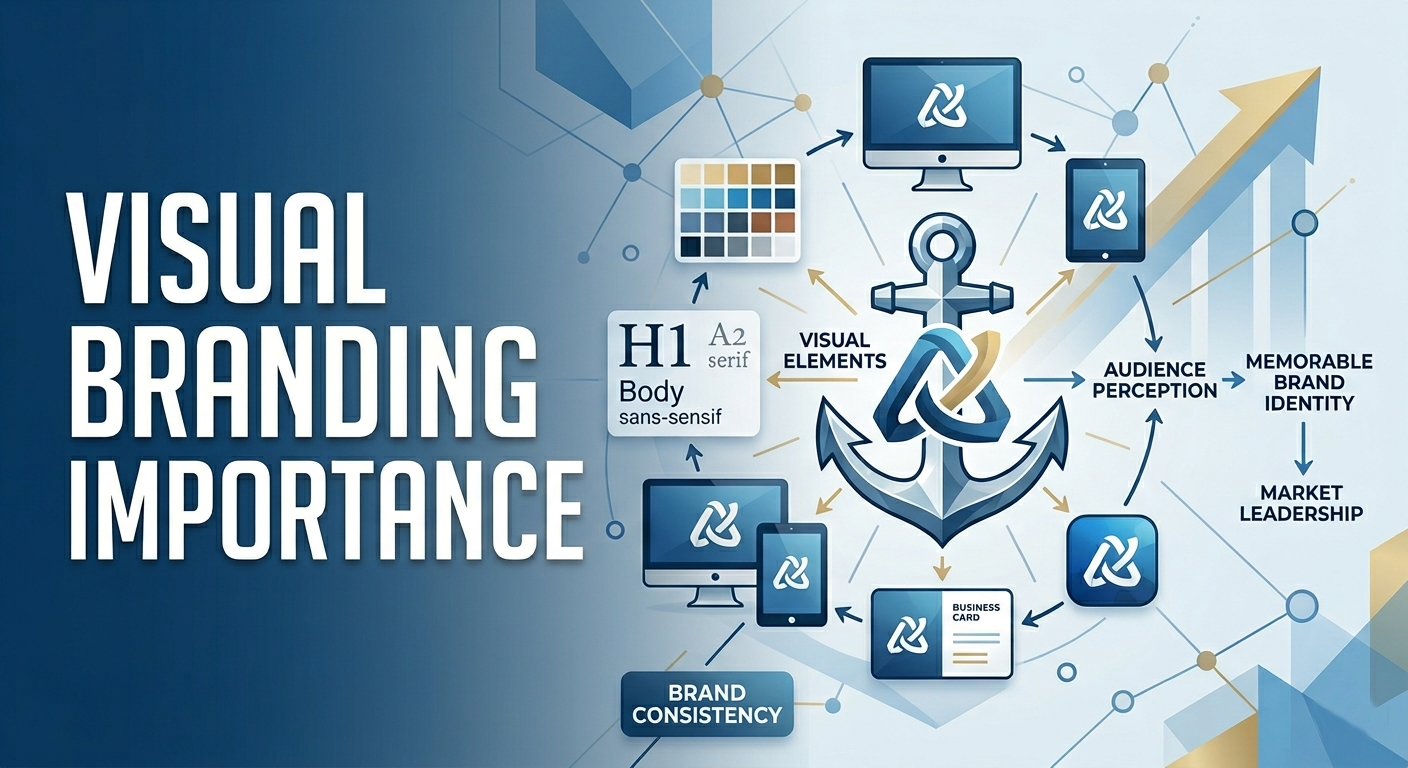
For modern businesses, your visual assets, your logo, color palette, typography, and imagery are the absolute foundation of how the world interacts with your business. They form the initial handshake, the silent pitch, and the emotional anchor that ties a consumer to your business.
Let’s dive deep into why visual branding is the ultimate growth lever for your business, how it shapes consumer psychology, and how you can leverage it to dominate modern search engines.
1. First Impressions and the Psychology of Design
You only get one chance to make a first impression, and in the digital space, that window is microscopic. Studies show it takes users about 50 milliseconds (0.05 seconds) to form an opinion about your website and determine whether they’ll stay or leave. This instant reaction highlights the critical visual branding importance in capturing immediate user interest.
Human brains are hardwired to process visual data incredibly fast. In fact, visual information is processed up to 60,000 times faster than plain text. Long before a potential customer reads your expertly crafted about page or scrolls through your product features, they are subconsciously decoding your brand’s visual signals.
Shaping Brand Perception
Your visual identity directly influences brand perception, which is the mental association, feeling, or opinion a consumer forms about your business.
- Color Psychology: A tech company utilizing deep blues signals stability, security, and trust. Meanwhile, a wellness brand using soft greens and earth tones instantly communicates health, tranquility, and sustainability.
- Typography & Layout: Clean, minimalist sans-serif fonts suggest modern innovation and efficiency, while classic serif typography evokes a sense of heritage, authority, and premium quality.
When your visual design elements align perfectly with your core values, your target audience feels an immediate sense of alignment. If your visuals look amateurish, outdated, or chaotic, consumers will instantly project those negative traits onto the quality of your products or services.
2. Cultivating Consumer Trust and Professionalism
Trust is the ultimate currency in commerce. Without it, even the most innovative products will fail to sell. Recognizing the true visual branding importance is essential because a polished, high-end visual aesthetic acts as an immediate shorthand for operational legitimacy and professional capability.
When a company invests time and resources into creating a high-quality visual framework, it sends a clear signal to the market: “We are here to stay, and we care about the details.”
- High-Quality Visual Assets $\rightarrow$ Signals Legitimacy & Care $\rightarrow$ Lowers Perceived Purchase Risk $\rightarrow$ Higher Conversion Rates
Building Authority in a Noisy Market
A cohesive brand kit featuring professional graphic design, custom iconography, and high-quality photography lowers the perceived risk of doing business with you.
Consider two competing digital service providers. One has an outdated website, generic stock photos, mismatched fonts, and a low-resolution logo. The other features a sleek, unified design style, a distinct color palette, and bespoke visuals.
Even if their pricing and skills are identical, consumer trust will overwhelmingly shift toward the visually superior option. Professional design tells the customer that you take your own business seriously, meaning you are highly likely to take their business seriously too.
3. Driving Customer Loyalty Through Consistency
Attracting a new customer is only half the battle; the real sustainable growth lies in retention. This is where understanding visual branding importance intersects directly with long-term profitability. A unified visual footprint ensures that your brand remains memorable across every single touchpoint.
To turn casual buyers into lifelong advocates, you must maintain absolute brand consistency. This means your visual assets must look, feel, and breathe the same way whether a customer is looking at:
- A physical product package or shipping box.
- An Instagram story or LinkedIn graphic.
- A digital invoice or email newsletter header.
- Your official website or mobile app interface.
The Power of Recognition
When a customer sees your signature brand colors or custom typography repeatedly across different platforms, it reinforces their familiarity with your business. Over time, this repetition breeds a powerful sense of comfort.
Think about global giants like Target or Apple. You can spot their advertisements from a distance without even reading their name, simply by their distinct red bulls-eye or ultra-minimalist layout.
That level of effortless recognition is the direct result of unwavering visual consistency, and it heavily tilts consumer choice in your favor when they are ready to make a purchase.
4. Standing Out in a Saturated Market
No matter your industry, you are likely competing against dozens, if not hundreds, of similar businesses offering comparable features and pricing models.
When functional differences between products are minimal, your visual identity becomes your primary competitive advantage. Embracing visual branding importance gives you the tools to break through the digital noise and carve out your own unique market space.
Market Navigation: How Identity Changes the Game
- Option A: Generic Visuals
- Blends directly into the industry noise
- Forces you to compete solely on low pricing
- Results in low memorable value and high churn
- Option B: Distinct Brand Identity
- Leverages high-impact visual assets
- Builds an emotional customer connection
- Unlocks premium pricing power and market authority
The Visual Differentiation Strategy
A generic brand that relies on basic templates and standard assets will always find itself trapped in a race to the bottom, forced to compete purely on low pricing. Conversely, a business with a highly distinctive visual style stands out instantly.
Your visual assets allow you to show, rather than tell, what makes you different. It could be a bold, unconventional layout, an unexpected color combination, or a highly personalized illustrative style.
By creating a unique visual language, you stop being an interchangeable option and become a distinct, memorable destination.
5. Emotional Connection and Storytelling
Human beings like to think they make entirely logical purchasing decisions based on data, pricing, and features.
However, behavioral economics tells a completely different story: the vast majority of our buying choices are driven by emotion. Deeply understanding visual branding importance allows you to leverage this reality by using design as a powerful vehicle for brand storytelling.
Every graphic asset, photography style, and design choice tells a story about who you are. A brand that uses candid, unedited, warm-toned photography tells a story of community, authenticity, and human connection.
On the other hand, a brand that utilizes crisp, stark, geometric patterns and high-contrast visuals tells a story of precision, cutting-edge technology, and futuristic efficiency.
The Consumer Decision Pipeline
- Visual Input: Processing colors, typography, and imagery.
- Emotional Response: Instant feelings of trust, excitement, or comfort.
- Conscious Rationale: The brain justifies the feeling (“This product fits my exact needs.”).
Visuals trigger an immediate visceral reaction before the conscious mind even processes your copy. By selecting design elements that mirror the aspirations, lifestyles, and feelings of your target audience, you build an authentic emotional bridge.
When consumers connect with your brand on an emotional level, they don’t just buy your products; they integrate your brand identity into their own personal lifestyle.
6. Optimization for Modern Search: SEO, AEO, and GEO
Historically, branding and search engine optimization lived in completely separate silos. Today, they are deeply intertwined. The ultimate proof of visual branding importance lies in how modern AI-driven search engines evaluate, categorize, and rank your digital presence.
To rank on the first page of Google and succeed across modern search landscapes, your visual assets must be optimized for three distinct paradigms:
Search Engine Optimization (SEO)
Google’s search algorithms place immense value on user experience (UX) and engagement metrics, such as time-on-site and bounce rates. A visually stunning, easy-to-navigate website keeps users scrolling longer, directly signaling to Google that your content is highly valuable.
Furthermore, optimizing your image file names, utilizing descriptive alt text with relevant keywords, and implementing structured data schemas ensure your visual assets rank prominently in Google Images, driving massive secondary traffic streams.
Answer Engine Optimization (AEO)
Voice assistants and conversational search tools (like Google Assistant or Siri) pull answers from highly structured, authoritative sources. When your visual content is paired with clear, direct informational headings and clean layouts, answer engines can easily parse your page structure, increasing your chances of being featured as the definitive voice answer or featured snippet.
Generative Engine Optimization (GEO)
Next-generation, AI-first search platforms (like Gemini, ChatGPT, and Perplexity) don’t just deliver a list of blue links; they synthesize comprehensive answers using multi-modal data.
These engines look for authoritative brand signals across the web. A highly consistent visual identity accompanied by clear, well-labeled infographics and diagrams makes your content incredibly attractive to AI engines, which frequently embed these clear visual assets directly into their generated responses.
7. How to Implement an Effective Visual Strategy
Knowing the theoretical value of design is a great start, but execution is what drives real-world revenue. Prioritizing visual branding importance requires a structured, deliberate approach to building your public-facing identity. It’s about moving away from ad-hoc graphics and moving toward a highly strategic, repeatable system.
$$\text{Brand Strategy Core} \longrightarrow \text{Comprehensive Brand Kit} \longrightarrow \text{Standardized Style Guide} \longrightarrow \text{Multi-Channel Launch}$$
Step-by-Step Visual Execution
- Define Your Brand Identity Core: Before designing anything, clarify your mission, target audience, and core emotional traits. Are you playful or serious? Traditional or disruptive?
- Develop a Comprehensive Brand Kit: Partner with skilled professional designers to build your core assets. This includes your primary and secondary logos, a defined typography hierarchy, and a strict color palette.
- Publish a Standardized Brand Style Guide: Document every single design rule in a centralized style guide. Specify exact color hex codes, font sizes, and rules for graphic spacing to maintain absolute brand consistency.
- Audit Every Customer Touchpoint: Review your entire digital ecosystem. Update your website, social media profiles, email templates, and marketing materials to ensure they perfectly reflect your updated visual language.
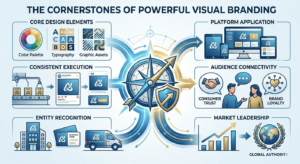
Summary Table: Visual Branding Core Components
To keep your design strategy organized, use this quick-reference matrix to track how individual visual components influence your broader market presence.
| Visual Component | Core Purpose | Direct Impact on Business |
| Logo Design | The primary anchor of your brand’s public identity. | Instant market recognition and memorability. |
| Color Palette | Triggers immediate psychological and emotional responses. | Deeply shapes initial brand perception. |
| Typography | Sets the stylistic tone and readability of your content. | Establishes professionalism and operational authority. |
| Imagery Style | Communicates your authentic brand story and values. | Builds a deep emotional connection with your audience. |
| Layout & Grid | Dictates user navigation flow and digital accessibility. | Boosts user engagement metrics for higher SEO rankings. |
Frequently Asked Questions (FAQs)
Why is visual branding importance critical for a brand-new startup?
For a brand-new startup, you do not yet have market history, extensive reviews, or massive brand awareness to lean on. Your visual branding acts as your initial credential. A highly polished, professional visual presentation immediately establishes marketplace legitimacy, making potential customers feel safe purchasing from a new entity.
How does brand consistency in visual design directly impact revenue?
Brand consistency removes cognitive friction for the consumer. When your visuals are unified across all platforms, it builds a cohesive, dependable image. This constant reinforcement accelerates the customer journey from initial awareness to absolute trust, which directly improves conversion rates and boosts repeat purchase metrics.
What role does brand perception play in a company’s pricing strategy?
Your visual assets establish the perceived value of your products or services. Premium, intentional graphic design alters consumer brand perception, allowing you to command significantly higher, premium price points. Conversely, weak or uninspired visuals cheapen your brand image, forcing you to compete solely on low pricing.
Can poor visual branding harm my website’s SEO and search rankings?
Yes, absolutely. If your website features a chaotic layout, low-contrast typography, or confusing visual hierarchies, users will experience high frustration and leave your site almost immediately. This rapid exit increases your bounce rate and slashes your average session duration, negative user experience signals that tell Google your site is unhelpful, which can lead to a drop in search rankings.
How often should a business update its visual identity assets?
A complete visual overhaul shouldn’t happen frequently, as it can confuse your existing audience and damage established recognition. However, a subtle visual refresh every 3 to 5 years is highly beneficial. This keeps your brand looking contemporary, modern, and perfectly aligned with evolving digital design standards without losing the core visual elements your customers already know and love.
Read our other articles:
The Ultimate Guide to Brand Identity Design in 2026
Rebranding Strategy Guide: 2026 Trends & Proven Steps
Technical SEO Guide: Boost Your Website Performance