Every growing business eventually faces a high-stakes crossroads: should you invest your hard-earned capital into immediate visibility, or should you spend time building an evergreen digital footprint? It is the classic debate of paid ads vs organic marketing, and choosing the wrong focus too early can drain your budget or leave your pipeline completely dry.
In today’s fast-evolving search ecosystem, where traditional search results blend seamlessly with AI-generated answers, voice search, and conversational discovery engines, this decision requires looking beyond basic metrics. It requires understanding how customer acquisition costs (CAC) balance against long-term brand equity.
If you are trying to determine where to allocate your marketing budget, this breakdown explores the mechanics, costs, and hidden truths behind both approaches to help you pick the winning strategy.
What is the Core Difference?
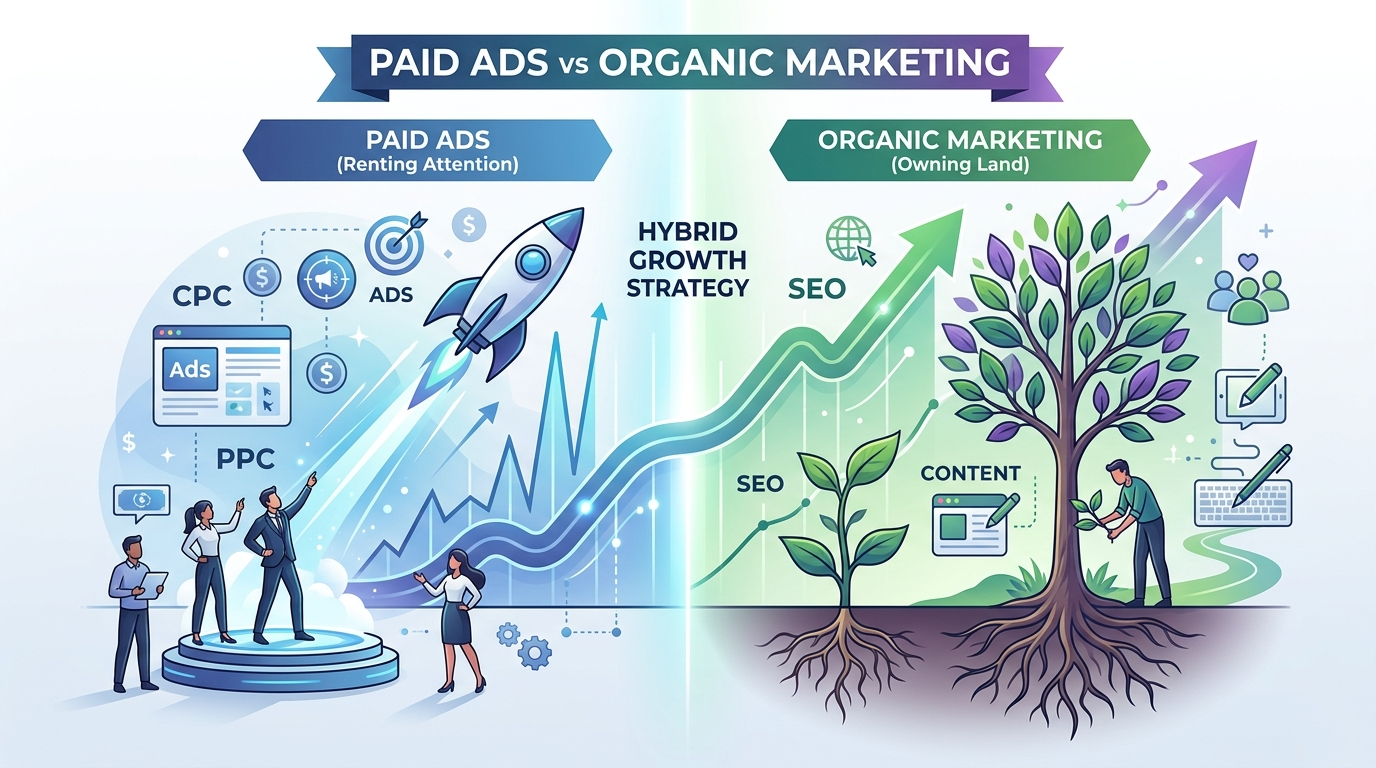
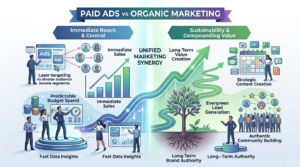
At its most fundamental level, the debate over paid ads vs organic marketing comes down to one core trade-off: renting attention vs. owning land.
The Core Marketing Trade-Off
- Paid Marketing: * Renting target audience attention on third-party networks.
- Provides immediate market traction and traffic influxes.
- Cost scales linearly with the volume of traffic received.
- Functions as a linear growth engine.
- Organic Marketing: * Owning your digital real estate and web presence.
- Focuses on long-term, compounding asset generation.
- Upfront effort yields continuous, free traffic streams.
- Functions as an exponential growth engine.
When you deploy paid advertising, you are paying a digital platform to display your messaging directly in front of an audience. The moment your budget stops, your visibility stops.
Organic marketing, conversely, focuses on earning your audience’s attention naturally over time. By creating valuable content, building a community, and optimizing your website, you establish a digital asset that continues to attract prospects long after the initial work is completed.
1. Speed and Market Traction: The Immediate vs. Long-Term Play
When evaluating paid ads vs organic marketing, speed to market is usually the primary differentiator. If you need sales or leads by tomorrow morning, organic strategies will not help you.
Paid media provides an instant on-ramp to visibility. Through a dynamic digital ads comparison, we see that platforms like Google Ads, Meta, and LinkedIn allow you to bypass the traditional queues.
Within minutes of launching a campaign, your brand can appear at the absolute top of search feeds or directly inside a user’s social timeline. This makes paid initiatives incredibly useful for:
- Testing new product concepts or messaging variants.
- Securing immediate traction for time-sensitive seasonal promotions.
- Driving predictable volume during critical sales quarters.
Organic marketing is a compounding engine. It takes weeks, or sometimes months, for search engines to index your content, understand its authority, and reward it with high placement.
However, this patience yields a massive structural advantage: scalability without a linear cost increase. While a paid ad click costs money every single time, an organic visitor arriving via an educational blog post costs nothing at the point of consumption.
2. Budgetary Mechanics: Upfront Costs vs. Long-Term Value
The financial frameworks of paid ads vs organic marketing operate on completely opposite tracks. Understanding the nuances of PPC vs SEO requires a deep look at how cash flow translates into customer acquisition.
Investment & ROI Lifecycle
Paid Ads (PPC)
- Continuous Capital Outflow: You must pay for every single interaction, click, or impression your brand receives.
- Immediate & Linear Returns: Revenue scales directly alongside your spending. If you cut the budget, traffic scales down immediately.
Organic (SEO)
- Heavy Initial Cost: Requires upfront capital or time allocation for content creation, development, and strategic asset design.
- Delayed, Compounding Returns: Traffic increases exponentially over time while your ongoing cost-per-click effectively drops to zero.
With pay-per-click (PPC) campaigns, your financial expenditure is highly visible and highly variable. You are competing in real-time auctions for user attention, meaning your costs fluctuate based on industry competition, seasonal demands, and ad quality scores.
The primary benefit is financial control: you can set strict daily caps, pause underperforming ads instantly, and track every single dollar spent down to the precise click.
Organic marketing demands a significant upfront investment, often in the form of content creation, technical website optimization, and graphic design, but features a dramatically shrinking cost per lead over time. If you invest money to write an authoritative, deeply helpful guide that addresses a major user pain point, that guide can rank well for years.
As it draws thousands of organic sessions monthly without a corresponding ad bill, your average cost per acquisition plummets, making organic marketing incredibly efficient in the long run.
3. Auditing Visibility: PPC vs SEO and the Click Landscape
Where your business appears on the search results page dictates the intent and quality of the traffic you receive. Analyzing a side-by-side comparison of paid ads vs organic marketing reveals a distinct split in how users interact with paid placements versus earned listings.
Search Engine Result Page (SERP) Visual Hierarchy
- Top Placements (Paid Ads – PPC): Highly visible, sponsored listings targeting direct commercial keywords (e.g., “Premium Solution for Enterprise Teams”).
- Middle Placements (AI Overviews – GEO/AEO): Conversational AI summaries pulling data directly from trusted industry guides and verified organic sources.
- Main Placements (Organic Results – SEO): Earned authority listings driven by relevance and comprehensive content (e.g., “The Definitive Guide to Workflow Tech”).
Paid search advertisements sit at the very peak of the page, occupying prime digital real estate. They target users with high commercial intent, people explicitly looking to buy, compare prices, or hire a professional immediately.
Organic listings position your business as a trusted authority. Many web users intentionally skip past sponsored tags to click on the top organic results, viewing them as more objective and trustworthy.
Additionally, with generative search engines pulling summaries directly from deeply optimized organic content, a robust organic presence is now the primary way to land your brand inside native AI responses.
4. Trust, Credibility, and Audience Retention
A critical, often overlooked element of the paid ads vs organic marketing dynamic is consumer psychology. The pathway you use to connect with a consumer heavily shapes how they perceive your company’s authority.
Paid ads excel at capturing attention, but they carry an inherent transactional bias. Modern buyers are highly sophisticated; they understand that an ad appears because a company paid for it, not necessarily because the solution is the highest-rated or most credible option on the market.
Consequently, paid conversions often require sharper, high-urgency offers and highly optimized landing pages to overcome initial buyer skepticism.
Organic marketing builds a bridge of credibility. When a user discovers your brand through a comprehensive resource, an unprompted social share, or an educational video, their psychological guard is down.
You have solved a problem for them before asking for a credit card. This positioning establishes deep brand equity, fosters consumer trust, and frequently results in higher customer lifetime value (LTV) and stronger referral rates.
5. Algorithmic Risk: The Stability of Ad Budgets vs. Organic Feeds
Every channel carries its own operational risks. In this digital ads comparison, security looks very different depending on whether you are working with paid ad networks or organic discovery channels.
Organic marketing lives at the mercy of platform algorithms. Search networks and social platforms regularly update their sorting logic to improve user experience, which can occasionally cause organic traffic to fluctuate.
Minimizing this risk requires a focus on structural quality: writing comprehensive, human-centric content, maintaining pristine technical site health, and ensuring an exceptional mobile user experience.
Paid marketing provides protection against these algorithmic shifts, but introduces a purely financial risk. If a well-capitalized competitor enters your space and aggressively outbids you on primary keywords, your cost-per-click can climb rapidly, squeezing your profit margins.
Furthermore, changes in privacy regulations and browser tracking restrictions mean paid ad targeting requires continuous monitoring and adaptation to remain highly accurate.
6. Synthesis: Building a Balanced Hybrid Marketing Engine
Rather than viewing paid ads vs organic marketing as an all-or-nothing choice, high-growth brands treat them as complementary elements of a single unified pipeline.
The Unified Growth Conveyor System
- Deploy Paid Ads: Instantly drive traffic to gather data, test conversions, and discover which specific search phrases yield actual revenue.
- Optimize Organic Engine: Take those proven, high-converting commercial keywords and build authoritative content around them to capture permanent, free search rankings.
- Execute Retargeting: Capture non-converting organic site visitors by serving them low-cost, targeted paid remarketing ads to pull them back through your conversion funnel.
You can use paid campaigns to generate instant cash flow and uncover high-converting search phrases. Those precise high-value keywords can then be fed straight into your long-term organic production queue, ensuring you spend time creating content only for terms with proven commercial value.
At the same time, your organic traffic creates a highly qualified audience pool that you can retarget with tailored, low-cost paid ads to capture prospects who did not buy on their first visit.
Frequently Asked Questions
Which option offers a better long-term return on investment?
When analyzing the multi-year trajectory of paid ads vs organic marketing, organic strategies generally provide a higher long-term ROI. While organic marketing requires substantial upfront execution and patience, it creates an enduring digital asset. The content continues to capture traffic and generate leads without a direct per-click cost, decoupling your growth from a continuous ad spend.
Can a business survive solely on organic marketing?
Yes, many companies grow entirely through organic channels like SEO, referral networks, content engines, and word-of-mouth. However, relying completely on organic channels means your early growth will likely be gradual. If you launch a brand-new product or enter a highly competitive market, adding a targeted paid layer can provide the initial momentum needed while your organic footprint builds.
How do I figure out how to split my budget between PPC and SEO?
Your ideal budget allocation depends heavily on your business lifecycle and cash flow requirements. Early-stage operations often split budgets 70/30 in favor of paid ads to rapidly drive revenue, validate product-market fit, and acquire data. Established organizations with healthy cash flows typically shift toward a 40/60 split, channeling more resources into organic production to lower their long-term customer acquisition costs.
How has the rise of generative AI changed this balance?
Generative search and AI search assistants have made organic optimizations even more critical. AI models pull their citations and recommendations directly from authoritative, structured, and deeply informative organic web pages. To remain visible across both traditional search engines and AI discovery tools, brands must invest heavily in high-quality, expert-led organic content.
Read our other articles:
Technical SEO Guide: Boost Your Website Performance
Master Your Content Marketing Strategy: 2026 Guide
10 Web Development Mistakes Killing Your Traffic (Fixed)