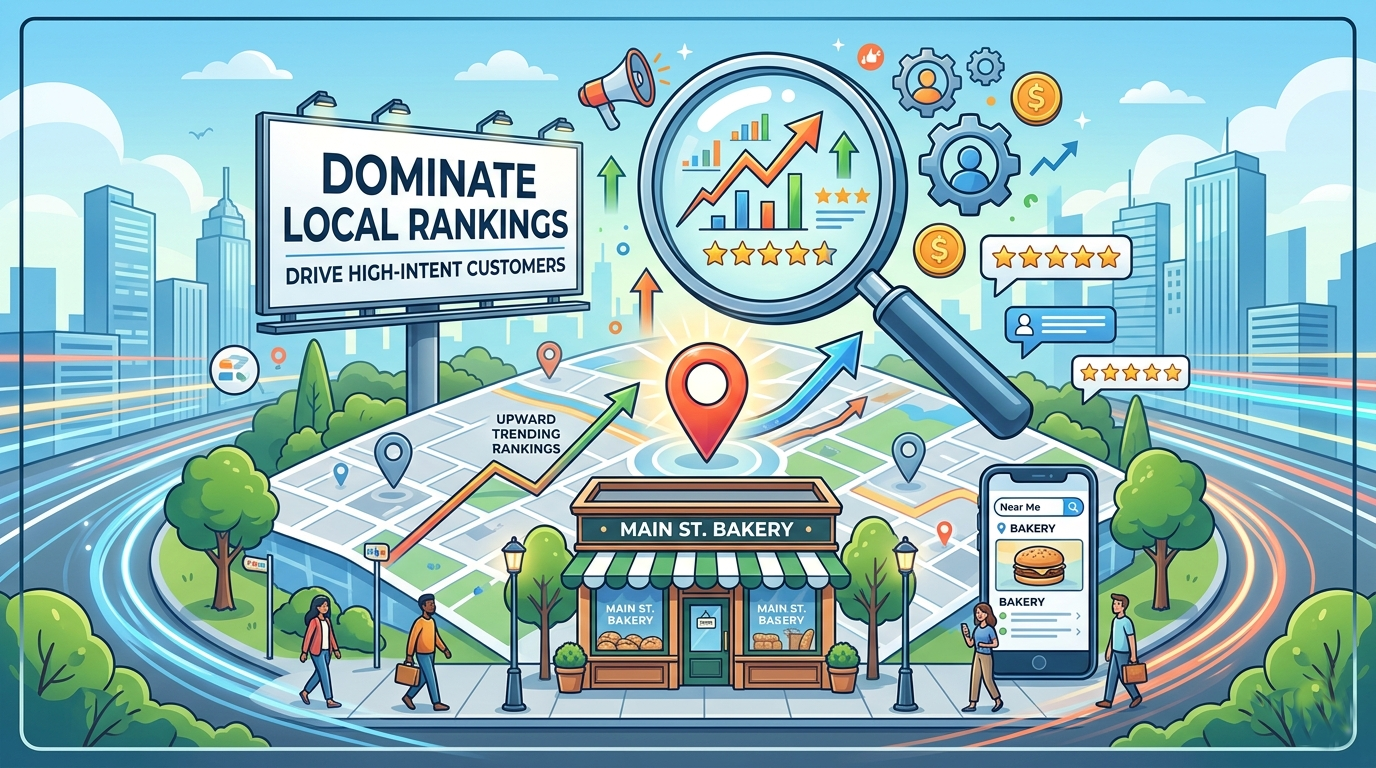
The modern customer journey doesn’t start on Main Street; it starts on a smartphone screen. Whether someone is looking for a “plumber near me” or the “best boutique coffee shop in downtown,” search engines dictate which local businesses get noticed and which stay invisible.
To win these high-converting customers, your business must deploy aggressive, modern local SEO strategies designed to capture top billing across traditional results and AI-driven search experiences.
Securing dominant positions in local search is no longer just about repeating a city name on your homepage. It requires a holistic framework that aligns with search intent, satisfies algorithmic trust signals, and leverages advanced schema markup.
1. Demystifying the Core of Local SEO Strategies
To build a sustainable digital presence, you must understand how search engines process local intent. Google uses three primary pillars to evaluate local rankings: relevance, distance, and prominence.
The Local Ranking Triad
- Relevance: How well your local business profile matches what someone is searching for.
- Distance: The physical proximity of your business location to the searcher or the geo-targeted location specified in the query.
- Prominence: The digital footprint and authority of your business, calculated via reviews, inbound links, mentions, and historical directory data.
When executing contemporary local SEO strategies, your goal is to maximize relevance and prominence. While you cannot alter physical distance from a searcher, you can ensure that your digital entity is so well-defined that search engines confidently surface your business over closer competitors.
2. Google My Business Optimization for Maximum Reach
The ultimate cornerstone of local rankings is your Google Business Profile (formerly known as Google My Business).
Think of this profile as the digital storefront that search engines use to populate the highly coveted Local 3-Pack and map views. Complete, meticulous Google My Business optimization acts as a direct data feed into Google’s local algorithm.
| Profile Optimization Element | Execution Blueprint | Impact on Local Rankings |
| Business Name & Core Category | Use your exact legal business name. Select the most precise primary category available. | Critical: Establishes primary keyword relevance. |
| Complete Business Data | Populate every field: operational hours, precise service areas, attributes, and secondary categories. | High: Maximizes matching capabilities for long-tail queries. |
| Geotagged Visual Media | Upload crisp, original photos of your interior, exterior, team, and projects regularly. | Moderate: Drives higher user engagement and click-through rates (CTR). |
| In-Platform Products & Services | Explicitly list your inventory, service menus, and accurate pricing tiers directly inside the dashboard. | High: Feeds contextual data to AI search overviews. |
To make your Google My Business optimization efforts truly impactful, treat your profile like a dynamic social media feed.
Publish weekly Google Updates regarding special offers, events, and helpful tips. This consistent activity signals to search engines that your business is operating, relevant, and highly attentive to consumer needs.
3. Mastering the Art of Local Citation Consistency
Beyond your primary profiles, search engines validate your physical real estate by cross-referencing information across the broader web.
This ecosystem relies on citations, any online mention of your business name, address, and phone number (commonly referred to as NAP data). Successful local SEO strategies demand absolute uniformity across these citations.
The NAP Uniformity Rule: If your address is listed as “Suite 400” on Google, it must not say “Ste. 400” or “#400” on Yelp, YellowPages, or your local Chamber of Commerce directory. Minor discrepancies fracture algorithmic trust.
Inconsistent NAP data confuses automated search bots, introducing doubt regarding the validity of your business location. When search engines doubt your data, your local rankings suffer immediately.
Focus on building clean, authoritative citations on Tier-1 aggregators like Data Axle, Neustar Localeze, and Foursquare, followed by highly targeted industry-specific directories.
4. Hyper-Local Content Creation Frameworks
If you want to move the needle on your local rankings, your website content cannot look like a generic corporate template. Your content architecture must reflect deep geographic roots, establishing your brand as a localized authority.
When brainstorming content under your local SEO strategies, move past generic keyword stuffing. Instead, build out location-specific landing pages for every distinct municipality or neighborhood you serve.
- Neighborhood Guides: Write comprehensive guides highlighting local landmarks, community events, and regional challenges that relate directly to your industry.
- Case Studies with Local Context: Instead of publishing “How We Repaired a Roof,” name your case study “Resolving Historic Tile Roof Leaks in [Neighborhood Name].”
- Local Event Sponsorships: Document your involvement with local charities, youth sports leagues, and business associations to earn contextually rich, localized mentions.
By framing your expertise within a defined geographic boundary, you build topical authority that search engines easily parse and reward with higher local rankings.
5. Engineering a Local Link-Building Ecosystem
In traditional search engine optimization, backlinks act as votes of confidence. In the local sphere, the geographic origin of those links matters far more than generic domain authority metrics.
A backlink from a highly respected local newspaper, high school, or regional blog carries immense weight within modern local SEO strategies.
To sustainably boost your local rankings, execute these local link-building tactics:
- Partner with Local Non-Profits: Offer pro-bono services or financial sponsorships to local charities in exchange for a link on their “Our Partners” page.
- Host Community Events: Organize educational workshops, blood drives, or networking events, and submit them to local community calendar websites.
- Local Resource Page Link Building: Identify regional blogs or resource sites that list top businesses in your area, and request inclusion based on your unique value proposition.
A handful of highly authoritative, geographically relevant links will do more for your local visibility than hundreds of low-quality, global directory links.
6. Architecting On-Page Elements and Schema Markup
To bridge the gap between traditional search engines and AI-driven platforms, your on-page technical optimization must be flawless.
Advanced local SEO strategies heavily leverage Local Business Structured Data (Schema Markup). This hidden code acts as a direct translation layer, allowing search engine bots to instantly extract your exact business hours, latitude, longitude, and accepted payment methods.
Ensure your website’s header and footer are optimized with clear, crawlable NAP text. Embed an interactive, verified Google Map directly on your contact page to confirm your physical coordinates.
Furthermore, optimize your Title Tags, H1 Headers, and Image Alt Text with geo-targeted keywords to provide immediate context regarding your operational footprint.
7. Review Management: The Digital Currency of Trust
Online customer reviews directly influence both consumer behavior and search algorithms. A steady influx of high-rating reviews is one of the single most powerful drivers for climbing local rankings and maximizing Google My Business optimization returns.
The Virtuous Local Review Feedback Loop
- Consistently Request Reviews: Create automated touchpoints immediately following a successful customer service delivery or product purchase.
- Target Industry & Geo Keywords: Gently prompt clients to mention the specific service they received and the city or neighborhood they live in.
- Reply Promptly to All Feedback: Always respond to every review—both positive and negative. Incorporate variations of your core terms naturally in your responses to add context.
By keeping review velocity high, you prove to search engines that your business remains actively engaged in the community.
8. Optimizing for AEO, GEO, and the Future of Voice Search
As generative AI engines fundamentally change how users consume information, traditional search engine marketing must evolve. Optimizing your digital footprint for Answer Engine Optimization (AEO) and Generative Engine Optimization (GEO) ensures your brand is selected as a definitive citation inside AI summaries and voice responses.
To maintain dominant local rankings across these AI ecosystems, adapt your local SEO strategies to prioritize natural language patterns.
Modern users don’t type fragments like “plumber Boston MA” into voice assistants or AI chat tools. Instead, they ask conversational questions: “Who is an affordable, 24-hour emergency plumber near the North End that fixes burst pipes?”
To capture this traffic, structure your website content around explicit question-and-answer pairs, build robust entity associations through structured data, and maintain an impeccable, unblemished online reputation that AI models can safely recommend without risk.
9. Monitoring, Analytics, and Continual Local Refinement
The digital marketplace is highly fluid. Your competitors are constantly adjusting their strategies to steal your local rankings. Therefore, tracking data and refining your approach is mandatory.
Monitor your Google Business Profile performance insights closely, paying close attention to direct actions: phone calls, website clicks, and driving direction requests.
Use localized rank tracking software to monitor your position within specific zip codes or geo-coordinates. By mapping out exactly where your visibility drops, you can deploy hyper-targeted local content and link-building campaigns to recapture lost real estate.
Frequently Asked Questions (FAQs)
What are the most effective local SEO strategies for businesses without a physical storefront?
Service-area businesses (like mobile mechanics or plumbers) can execute highly successful local SEO strategies by configuring their Google Business Profile to hide their physical address and define explicit geographic service boundaries. Focus heavily on building localized landing pages for every major city or suburb you travel to, and gather customer reviews highlighting your prompt on-site arrival within those specific zones.
How does Google My Business optimization directly impact map pack positions?
Comprehensive Google My Business optimization fills critical informational gaps in Google’s database. When your profile is completely filled out with accurate categories, service menus, and active updates, the algorithm can easily match your entity with highly specific user queries, resulting in increased visibility inside the Local 3-Pack and Google Maps.
Why are my local rankings dropping despite having consistent NAP data?
Local rankings can fluctuate due to several competitive factors. If your NAP data is pristine, your drop might be caused by an aggressive competitor acquisition of high-authority local backlinks, a sudden surge in fresh competitor reviews, or a recent search algorithm update that places a heavier weight on user proximity or entity prominence metrics.
How often should I audit my digital citations to preserve local rankings?
It is best practice to run a comprehensive citation audit at least twice a year. However, if your business changes its name, physical location, or main phone number, you must immediately audit and update your citations across all major digital platforms to prevent disjointed data from damaging your local SEO strategies.
Can implementing schema markup boost my Google My Business optimization results?
Yes. While schema markup is installed on your physical website rather than the Google dashboard, it provides structured validation of your business entity. When search engines crawl your site and find schema data that perfectly corroborates your Google Business Profile information, it solidifies algorithmic trust, lifting overall local rankings.
Read our other articles:
Rebranding Strategy Guide: 2026 Trends & Proven Steps
Technical SEO Guide: Boost Your Website Performance
Master Your Content Marketing Strategy: 2026 Guide